How to forecast Accounts Payable
Senior Manager Content Marketing at Medius
- Introduction
- What is AP forecasting?
- How do you calculate expected accounts payable?
- How do you use DPO to forecast accounts payable?
- Understanding the dynamics of Accounts Payable and Accounts Receivable
- Bridging the gap with Medius solutions
- Using automation to streamline Accounts Payable forecasting
- Enhance Accounts Payable forecasting with Medius
- FAQs: Accounts Payable Forecasting
Hear what's covered in this article:
Understanding how to project accounts payable is more than an accounting task; it's a strategic advantage in today's competitive business environment. Mastering the forecast accounts payable formula empowers your organization to navigate cash flow with precision, ensuring you're not just reacting to financial obligations but proactively managing them. This guide dives deep into forecasting accounts payable, providing you with the insights to maintain robust supplier relationships, leverage early payment discounts, and uphold a stellar brand reputation. Learn the art of forecasting accounts payable to transform your financial management strategy and secure your company's economic health.
As automation and AI tools become standard in finance operations, the approach to accounts payable (AP) forecasting is evolving. Modern forecasting combines historical data with predictive analytics, allowing finance leaders to forecast future obligations with greater precision and agility. AI-driven platforms like Medius AP Automation identify spending trends, detect anomalies, and automatically adjust forecasts based on real-time data. This helps finance teams plan cash flow with accuracy and reduces uncertainty as year-end or high-spend cycles approach.
What is AP forecasting?
AP forecasting is the strategic process of estimating the future outflow related to accounts payable within a specified period, usually a fiscal year. This practice is integral to managing a company's short-term obligations—those debts and expenses due for payment within a year. By accurately predicting these liabilities, organizations can optimize their cash flow, ensuring sufficient funds are available for both operational needs and strategic investments.

The first step in AP forecasting involves analyzing historical data and current financial obligations to project future expenditures. This approach allows businesses to anticipate upcoming payments, align their budgeting efforts, and maintain a solid financial foundation. Effective forecasting supports strategic decision-making, helping companies navigate through economic fluctuations and maintain a competitive edge in the market.
Incorporating AP automation tools significantly enhances the forecasting process. Automation provides real-time insights into financial commitments, streamlining the management of accounts payable. With access to accurate and timely data, businesses can make informed decisions, avoid late payment fees, and potentially secure early payment discounts. Automation not only improves efficiency but also reduces the likelihood of errors, contributing to more reliable financial forecasting.
Incorporating AI and predictive analytics into AP forecasting takes this process to the next level. With real-time invoice data, vendor terms, and spending patterns, AI models can refine forecasts as new transactions occur. These systems use machine learning to analyze trends, detect anomalies, and predict potential cash flow issues weeks ahead. The result is a more responsive, accurate, and actionable forecast that allows finance teams to pivot quickly and manage liquidity proactively.
Together, these strategies form the cornerstone of effective cash flow management, ensuring that businesses remain proactive in their financial planning. By mastering AP forecasting, companies can secure their financial health, uphold strong supplier relationships, and achieve greater operational efficiency.
Don’t wait to modernize your AP reporting with AI
The path to smarter, faster insights might be closer within your reach than you think. The “Guide to transforming reporting with AI-driven automation” shows how AI can eliminate manual effort, reduce errors, and deliver real-time visibility, making it possible to lead with data sooner, rather than later.

How do you calculate expected accounts payable?
Understanding how to project your company's future accounts payable is essential for maintaining liquidity and financial health. The process involves a few critical steps and calculations:
Total Accounts Payable Turnover (TAPT)
This metric helps gauge the efficiency of your AP management by analyzing your total purchases against your accounts payable.
Formula: The TAPT is calculated by dividing your total purchases by the average of your beginning and ending AP for a period. This average is then divided by 365 to determine the average accounts payable days, also known as Days Payable Outstanding (DPO).
TAPT = Total Purchases ÷ Average Accounts Payable
DPO Calculation
The DPO is crucial for understanding how long it takes your company to pay its obligations. A higher DPO can indicate better cash flow management but requires a balance to maintain good supplier relationships.
Formula breakdown:
- Step 1: Calculate your average accounts payable (Beginning AP + Ending AP) / 2.
- Step 2: Identify your total purchases for the period.
- Step 3: Apply the DPO formula: Average Accounts Payable / (Total Purchases / 365)
Forecast future AP using DPO
Once you have your DPO, you can forecast future accounts payable using this equation:
Formula: Forecasted AP = (DPO × Forecasted Cost of Goods Sold) ÷ 365
This provides a baseline projection of expected payment obligations. To refine accuracy, include adjustments for:
- Seasonality: Predictable high or low spending cycles
- One-time purchases: Major equipment or project expenses
- Vendor terms: Net 30, 45, or 60 structures that shift cash flow timing
- Growth: Anticipated increases in purchasing volume
Automation platforms like Medius Analytics can monitor these factors continuously, adjusting forecasts in real time and providing predictive insight into how vendor activity or pricing changes will impact cash flow.
Incorporating Medius AP Automation into your financial operations can significantly enhance the accuracy and efficiency of forecasting accounts payable. Medius streamlines this process with cloud automation, ensuring timely and precise calculations essential for strategic decision-making. This advanced solution supports companies in maintaining a competitive edge in rapidly changing markets by aligning financial strategies with organizational objectives through standardized methodologies and detailed cost data analysis.
See AI-driven automation in action
Reading about predictive insights is one thing; seeing them come to life is another. Watch these Medius demos to see how AI-powered visibility and analytics help finance teams forecast with greater accuracy, anticipate risks, and make faster, more confident decisions.

How do you use DPO to forecast accounts payable?
DPO is a critical metric for understanding how long a company takes to pay its invoices. Understanding the days of payable outstanding (DPO) helps management and the AP team find ways to streamline operations and improve cash flow. To figure out the DPO, use the formula DPO = Accounts Payable X Number of Days (COGS).
Next, review why the organization’s goal is a high DPO versus a low DPO. For example, a company may maintain a high DPO to have the additional cash flow for investments. On the other hand, establishing a low DPO helps companies realize discounts for early payments and build strong supplier relationships. In addition, AP automation reduces the time it takes to pay invoices, improving efficiency and helping companies save money.
Modern forecasting models build on DPO to show how payables influence total working capital. AI forecasting tools can simulate multiple DPO scenarios, predicting how changing payment cycles or supplier terms might affect liquidity, credit exposure, or discount capture. These simulations help finance leaders identify optimal DPO ranges that balance cash conservation and supplier trust.
Understanding the dynamics of Accounts Payable and Accounts Receivable
Navigating corporate finance requires effective management of Accounts Payable (AP) and Accounts Receivable (AR), crucial for sustaining a company's financial well-being and operational efficiency. Two key components of this financial management are Accounts Payable (AP) and Accounts Receivable (AR), each playing a pivotal role but on opposite ends of the financial spectrum.
Accounts Payable (AP): The Outflow Engine
What makes AP unique:
AP refers to the obligations a company has to pay off within a short period, typically less than a year. These are the amounts owed to suppliers or vendors from whom the company has purchased goods or services on credit. As a liability, AP is crucial for managing cash outflows effectively.
Why AP is important:
Efficient AP management ensures that a company can meet its obligations without incurring late fees or damaging supplier relationships. It reflects a company's operational efficiency and its ability to manage its debts prudently.
Accounts Receivable (AR): The Inflow Anchor
What makes AR unique:
In contrast, AR represents the money that others owe to the company for goods or services delivered. It is considered an asset because it is expected to be converted into cash in the future. AR arises from credit sales, where the company extends a line of credit to its customers.
Why AR is important:
Effective AR management is vital for ensuring that the company has a steady inflow of cash. It is indicative of the company's market competitiveness and its ability to convert sales into cash efficiently.
Bridging AP and AR data using automation delivers one of the most powerful cash flow advantages. Real-time synchronization between outgoing and incoming payments ensures that finance teams can forecast net positions with accuracy. Medius enables this connected view through Medius AP Automation and Medius Analytics, giving organizations the ability to align receivables and payables for more precise forecasting and working capital control.
Bridging the gap with Medius solutions
Medius provides innovative solutions that streamline AP processes, enhancing financial control and operational efficiency. By automating AP, Medius helps companies optimize their cash flow management, reduce processing times, and improve overall financial visibility. Although Medius focuses on AP automation, efficient AP management indirectly benefits AR by stabilizing cash flow, allowing businesses to invest in growth opportunities and maintain a strong financial position.
Incorporating Medius' AP automation tools into your financial strategy not only simplifies the management of accounts payable but also supports a more holistic approach to financial operations, ensuring that both AP and AR contribute positively to the company's financial health.
Using automation to streamline Accounts Payable forecasting
Integrating advanced automation into your accounts payable forecasting doesn't just simplify workflows—it revolutionizes them. By leveraging Medius' cutting-edge AP automation solutions, businesses can achieve a level of precision in projecting accounts payable that manual processes simply cannot match. This precision facilitates more strategic financial planning and a proactive approach to cash flow management.
Medius' platform automates the tedious, error-prone tasks associated with accounts payable management, from invoice processing to final payment, ensuring data accuracy and freeing up valuable time.
Gain immediate access to financial data that informs timely decision-making, allowing your organization to anticipate future cash flow needs accurately and adjust strategies dynamically.
With a clearer view of your financial obligations, your team can more effectively negotiate terms and manage working capital, ensuring your business remains agile and responsive to market changes.
Leading AP teams now use AI forecasting to detect spend trends, adjust for seasonality, and refine projections continuously. Medius Analytics applies predictive modeling to thousands of transactions to surface insights on upcoming liabilities, helping businesses avoid cash flow shocks and strengthen their forecasting discipline.
Incorporating Medius not only streamlines AP tasks but also empowers your organization with strategic forecasting tools. For a deeper dive into forecasting principles that complement AP automation, explore Forecasting Balance Sheet Items in Financial Models, a valuable resource for enhancing your financial modeling skills.
Enhance Accounts Payable forecasting with Medius
Mastering the art of forecasting accounts payable is pivotal for your organization's financial efficiency. Through Medius' AP automation services, navigating the complexities of cash flow management becomes streamlined, allowing for enhanced decision-making and optimized workflows. Embrace the opportunity to refine your financial strategies, ensuring your team can dedicate more effort to value-adding activities, such as securing early payment discounts.

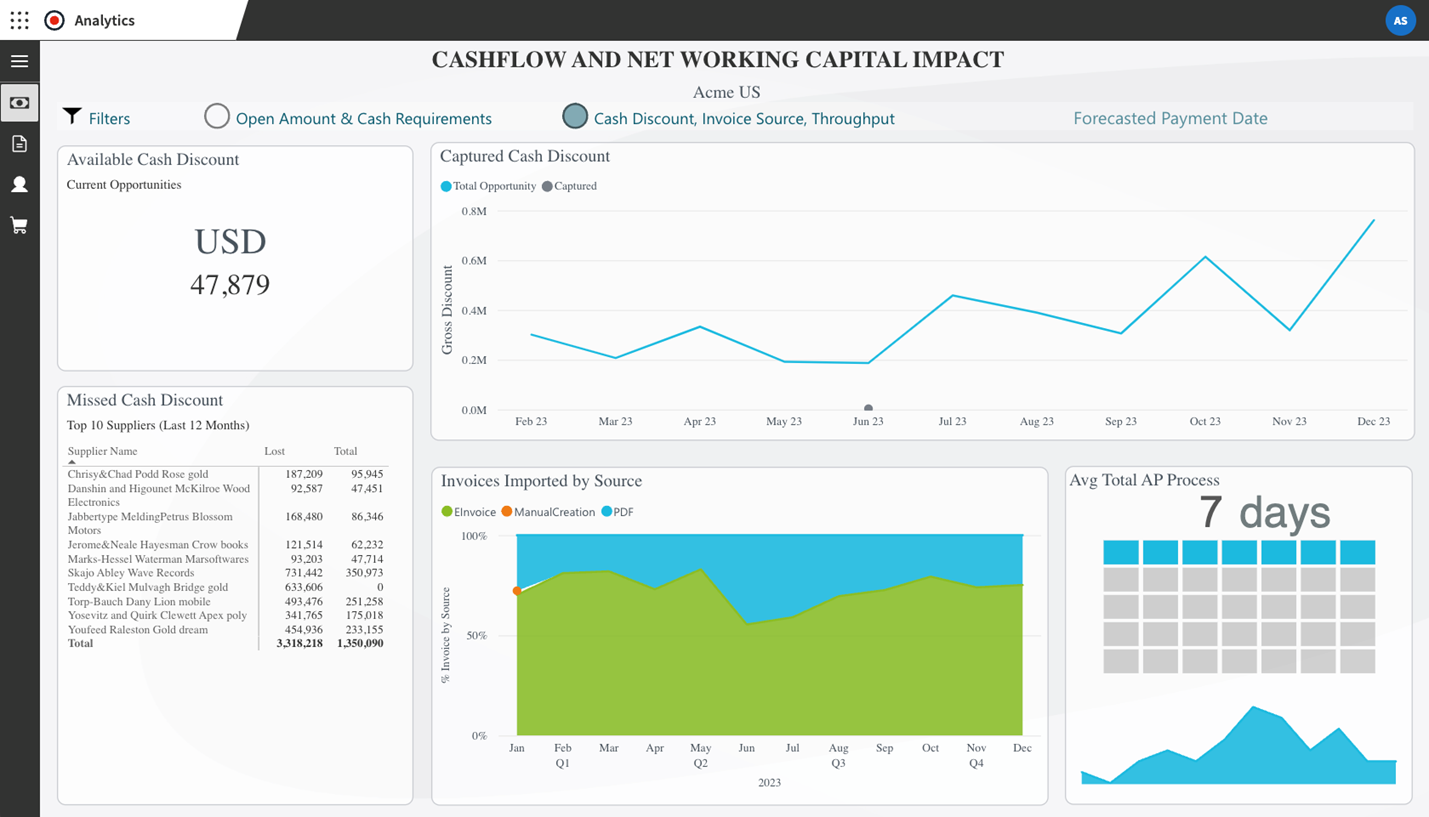
Discover how Medius can transform your accounts payable forecasting and elevate your financial operations. Reach out to explore our solutions and take a significant step towards optimizing your cash flow management.
FAQs: Accounts Payable Forecasting
It’s the process of predicting future liabilities so finance teams can manage cash flow proactively. Reliable AP forecasts help businesses plan for growth, avoid shortfalls, and capture early payment discounts.
AI tools analyze historical payment data, supplier terms, and real-time invoices to automatically adjust forecasts. This reduces manual input and increases precision, giving finance leaders greater confidence in their projections.
Relying solely on static spreadsheets, failing to factor in seasonal spending, and ignoring vendor term variations can all lead to inaccurate forecasts. Automation helps mitigate these risks.
Medius integrates automation and analytics, capturing invoice data as it’s processed and applying AI to predict future obligations. This ensures cash flow forecasts remain dynamic and always reflect the latest financial reality.
Yes. Consistent, predictable payment timing improves supplier trust and may open opportunities for better terms or discounts.
Key metrics include Days Payable Outstanding (DPO), Total Accounts Payable Turnover (TAPT), and forecast variance between projected and actual spend. Monitoring these ensures ongoing accuracy and control.


