How manufacturing AP teams eliminate exceptions with intelligent automation
- Introduction
- Why invoice exceptions are so common in manufacturing
- Reducing exceptions without replacing SAP
- Automating three-way matching at scale
- Improving approval routing and visibility
- Flagging risk and strengthening controls
- Accelerating time to value through modular automation
- Supporting better supplier collaboration
- Using data to continuously improve AP performance
- What to look for in intelligent automation tools
- Building a more resilient AP operation
- Frequently asked questions
Hear what's covered in this article:
Manufacturing accounts payable teams are under increasing pressure. Invoice volumes continue to rise, supplier networks grow more complex, and expectations for speed and accuracy keep climbing. At the same time, many teams are still managing invoice exceptions and approvals through manual processes that slow operations and limit visibility.
Exception handling has become one of the biggest obstacles to AP efficiency in manufacturing environments. Price mismatches, missing receipts, and approval delays pull teams into reactive work that consumes time and increases risk. Intelligent automation offers a path forward by embedding controls directly into the invoice workflow and reducing the need for manual intervention.

By modernizing how invoices are captured, matched, and approved, manufacturing organizations can move from constant exception management to predictable, scalable AP operations.
Why invoice exceptions are so common in manufacturing
Manufacturing AP teams face challenges that are unique to their industry. Purchase orders often span multiple deliveries. Partial receipts are common. Pricing may fluctuate based on volume, materials, or contract terms. Maintenance, repair and operation (MRO) needs spring up unpredictable invoice patterns. These variables create ideal conditions for exceptions during invoice processing.
When teams rely on manual checks or disconnected systems, even small discrepancies can halt progress. Invoices get routed for review, approvals stall, and payments are delayed. Over time, these bottlenecks reduce throughput and strain relationships with suppliers.
As invoice volumes increase, the problem compounds. Teams spend more time resolving issues than processing clean invoices. Visibility suffers, and leadership loses confidence in cycle time and accuracy.
Reducing exceptions without replacing SAP
Many manufacturing organizations rely on SAP to manage procurement and financial operations. While SAP, along with many other ERPs prevalent in the Manufacturing sector, provides a strong foundation, it is not always optimized for handling high exception volumes or complex approval scenarios without customization.
Medius integrates directly with SAP as well as many of the leading ERP systems, allowing teams to modernize AP processes without replacing core software. Instead of reworking ERP configurations, automation is layered on top to manage invoice intake, validation, and routing.

Rules can be applied automatically based on plant, supplier, spend level, or document type. This allows exceptions to be handled consistently across locations while preserving existing system structures. Teams gain flexibility without disruption.
Automating three-way matching at scale
Three-way matching is essential in manufacturing, but it is also a major source of delays. Differences between invoices, purchase orders, and goods receipts often require manual review, even when discrepancies fall within acceptable thresholds.
Intelligent automation applies predefined tolerances to matching logic. Minor variances can be approved automatically, while true exceptions are routed to the right person with full context. This reduces noise and allows AP teams to focus on issues that actually require attention.
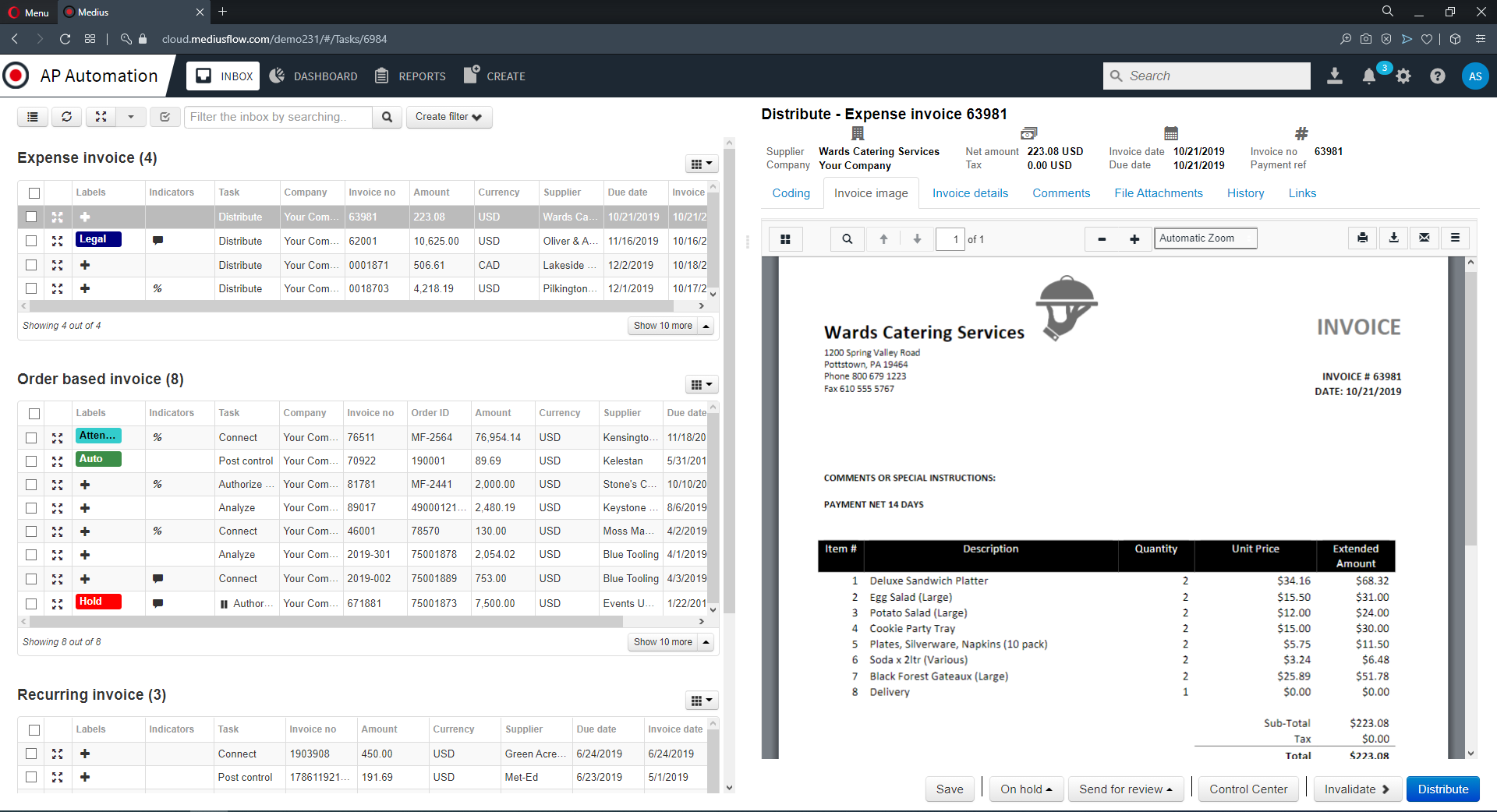
Invoice automation plays a key role here by capturing data accurately from the start and ensuring invoices are validated before matching begins. Clean data reduces downstream issues and shortens cycle times across the board.

Improving approval routing and visibility
Approval delays are another major contributor to exception backlogs. In manufacturing organizations with multiple plants and cost centers, invoices often sit idle while teams track down the right approver.
Automation resolves this by enforcing structured approval workflows. Invoices are routed automatically based on predefined rules, with escalation paths built in. Approvers receive the information they need upfront, reducing back and forth and speeding decisions.
With better visibility into invoice status, AP leaders can identify bottlenecks early and take corrective action before delays impact suppliers or reporting.
Flagging risk and strengthening controls
Exception-heavy environments also increase exposure to fraud and error. Duplicate invoices, altered vendor details, or unusual pricing patterns can be difficult to spot manually, especially at scale.
By applying AI innovation, intelligent automation continuously monitors transactions for anomalies. Suspicious activity is flagged in real time, allowing teams to intervene before payments are released. These controls strengthen governance without slowing routine processing.
Every action is logged automatically, creating a clear record that supports audits and internal reviews.


Accelerating time to value through modular automation
Manufacturing teams often hesitate to modernize AP because of concerns around complexity and timelines. Modular automation addresses this by allowing organizations to start where the impact is greatest.
Teams can begin with invoice capture and matching, then expand into approval routing, analytics, or risk monitoring as needs evolve. This approach delivers faster value and reduces change management burden.
Because Medius integrates seamlessly with existing systems, implementation focuses on process improvement rather than technical overhaul.
How Thorlux reduced AP exceptions for a brighter way to handle invoices

See how Thorlux, a global manufacturer of lighting equipment, improved efficiency, gained better visibility, and reduced manual exceptions by modernizing AP at scale with Medius
Supporting better supplier collaboration
When exceptions are frequent and payments are delayed, supplier relationships suffer. Vendors may submit duplicate invoices, follow up repeatedly, or escalate issues, creating more work for AP teams.
Automation improves collaboration by increasing accuracy and transparency. Suppliers receive timely payments, fewer invoices are rejected, and communication becomes more predictable. For a manufacturing customer, this reliability supports stronger partnerships and smoother supply chains.
Using data to continuously improve AP performance
Visibility is critical for long term improvement. With built in analytics, AP leaders can track exception trends, approval times, and root causes across plants and suppliers.
This insight allows teams to address issues upstream, such as improving purchase order accuracy or adjusting tolerances. Over time, exception rates decline and processing becomes more efficient.
Data driven improvement transforms AP from a reactive function into a strategic contributor.
What to look for in intelligent automation tools
For manufacturing AP teams evaluating automation solutions, certain capabilities are essential:
Automated 3-way matching with configurable tolerances
Rule based approval routing that reflects plant and cost center structures
Real time visibility into invoice status and exceptions
Integrated risk detection to reduce fraud exposure
Seamless integration with SAP and other ERP environments
AP automation should simplify processes, not add complexity. The right solution fits into existing workflows while delivering measurable improvements in speed, accuracy, and control.

From complex supplier networks to frequent invoice exceptions, manufacturing AP faces unique pressure points. Not every software is up to the task of meeting these challenges head-on. Find out how intelligent automation helps eliminate exceptions before they disrupt production and cash flow.
Building a more resilient AP operation
Manufacturing environments demand precision, scalability, and reliability. Manual exception handling cannot keep pace with rising volumes and increasing complexity.
Intelligent automation helps AP teams eliminate unnecessary exceptions, streamline approvals, and gain the visibility needed to operate with confidence. With Medius, manufacturing organizations can modernize accounts payable without disrupting core systems, creating a foundation that supports growth and resilience.
Explore how Medius helps manufacturing AP teams reduce exceptions, improve efficiency, and strengthen financial operations.
Frequently asked questions
They can use AP automation platforms that integrate directly with SAP, allowing rules-based exception handling and approval routing without replacing core systems. This approach enables faster processing while preserving existing ERP structures.
Frequent variables like partial deliveries, fluctuating prices, and complex purchase orders create mismatches during processing. When these are managed manually, even minor differences lead to delays and increased exception volume.
By applying configurable tolerances and validating invoice data upfront, automation can clear minor mismatches automatically. Exceptions that do require review are routed with context, reducing noise and speeding resolution.
Yes. Intelligent automation monitors for irregular activity such as duplicate invoices or unexpected vendor changes. It flags risks in real time and enforces controls that reduce opportunities for fraud.
They should prioritize solutions that support automated matching, structured approval routing, real-time visibility, SAP integration, and built-in analytics. These capabilities improve efficiency while reducing exception handling workload.


