Software Comparison
Medius vs. native ERP AP functionality
Why best-of-breed AP automation outperforms built-in ERP features

Why best-of-breed AP automation outperforms built-in ERP features
Native ERP AP functionality works well for organizations with straightforward accounts payable processes who primarily need basic invoice processing within their ERP. Medius, on the other hand, is built for organizations that want to take their ERP further with AI-powered automation, smarter workflows, analytics, fraud detection, and the ability to scale as their finance operations get more complex.

ERP AP modules can typically only:
They work well when invoices are low-volume, low-variance, and largely PO‑based. But most finance teams don’t stay in that world for long.
Common challenges with native
ERP AP functionality include:
Manual invoice capture and exception handling
Rule-based workflows that break with real-world complexity
Limited line-level visibility across non-PO invoices
Minimal fraud detection and risk controls
Reporting that shows what happened, not what needs attention

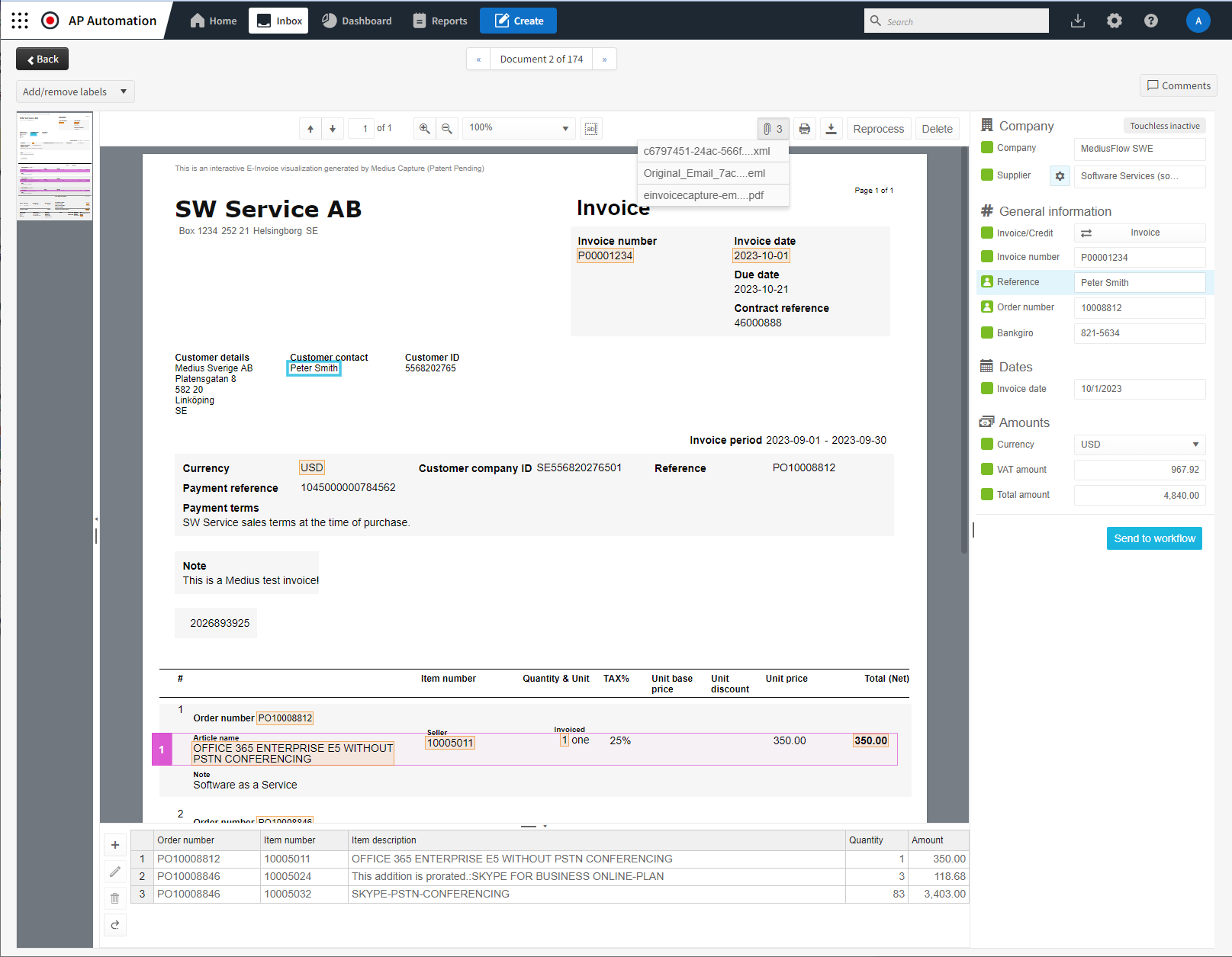
Medius is specifically for accounts payable, not as an add-on to a general ledger, but as a system designed to handle complexity from day one.
Where native ERP AP focuses on transaction processing, Medius focuses on automation, insight, and control.
The table below compares Medius with native ERP accounts payable functionality across
automation depth, scalability, risk management, and time-to-value.
| CAPABILITY / FEATURE | MEDIUS | Native ERP AP Functionality | |
 |
Invoice capture | AI-powered capture from any format (PDF, email, EDI, paper) | Manual or template-based capture |
 |
Line-level matching | Full AI-driven 2- and 3-way match at line level | Limited, rules-based matching |
 |
Non-PO invoice automation | Advanced AI coding and routing | Largely manual |
 |
Exception handling | Intelligent prioritization and automation | Manual review and rework |
 |
Fraud & risk detection | AI anomaly detection and risk scoring | Basic duplicate or rule checks |
 |
Supplier experience | AI-driven supplier conversations and status visibility | Limited portals or email follow-ups |
 |
Analytics & reporting | Real-time dashboards, insights, and benchmarks | Static or historical ERP reports |
 |
Scalability | Built for high volume, multi-entity, global AP | Performance declines with complexity |
 |
ERP flexibility | ERP-agnostic, works alongside your core system | Locked to one ERP |
 |
Time to value | Rapid, Medius-led implementation | Custom configuration and IT dependency |
Quick takeaway: Native ERP AP works for basic, low-volume scenarios. Medius helps organizations that need automation, visibility, and control as AP complexity increases.
Finance leaders often start with ERP-native AP because it’s built in.
They move to Medius when they need:
Higher automation rates beyond basic rules
Touchless processing across complex invoices
Better visibility into spend and bottlenecks
Stronger fraud protection
Faster approvals without manual chasing
An AP system that scales as the business grows
Native ERP AP is functional. Medius is transformational.
Medius doesn’t replace your ERP. It enhances it. Integrate your ERP with Medius with ease.
Your ERP remains the system of record. Medius becomes the system of action for AP.


Instead of piling more custom code into your ERP, IT teams can use modern AP automation to move invoice workflows to a smarter, easier-to-maintain platform that keeps the ERP clean and upgrades simple. See how.
Native ERP AP relies primarily on:
Medius uses AI to:
Native ERP AP may be sufficient if you have:
Low invoice volumes
Mostly PO-based invoices
Minimal supplier complexity
Little need for advanced reporting or fraud detection
Medius is the better choice if you have:
High or growing invoice volumes
Complex or non-PO invoices
Multiple entities or geographies
Lean AP teams under pressure to scale
A need for real-time visibility and control
See how Medius delivers AI-powered AP automation that scales beyond native ERP limitations without disrupting your core finance systems.
Native ERP AP functionality is often sufficient for organizations with low invoice volumes, simple approval workflows, and mostly purchase order-based invoices. As invoice complexity, supplier volume, and business growth increase, many organizations adopt dedicated AP automation to improve efficiency, visibility, and financial control.
Native ERP functionality is designed to process financial transactions. Dedicated AP automation platforms like Medius extend ERP capabilities with AI-powered invoice capture, workflow automation, fraud detection, supplier collaboration, analytics, and faster implementation.
No. Medius integrates with your ERP while allowing it to remain the system of record. Medius manages invoice capture, approvals, payments, supplier interactions, and analytics before synchronizing financial data back to the ERP.
Organizations often outgrow native ERP functionality when invoice volumes increase, approval workflows become more complex, multiple ERP systems or business entities must be supported, or finance teams need greater automation, visibility, and financial controls.
Native ERP functionality works well for basic AP processes. Organizations seeking enterprise scalability, AI-powered automation, advanced fraud detection, broader reporting, and source-to-pay capabilities will generally find Medius the stronger long-term solution.