Common types of accounts payable fraud and how technology reduces the risk
Senior Manager Content Marketing at Medius
Accounts payable fraud remains one of the most persistent financial control risks for modern finance teams. As invoice volumes increase and approval workflows become more decentralized, manual controls struggle to keep pace.
Understanding the most common types of AP fraud — and how automation prevents them — is essential to reducing financial leakage and compliance exposure.
Strategies around fraud have shifted with the interjection of AI into how fraudsters are targeting businesses. Organizations need to move away from reactive fraud review and use AI to fight new channels of risk, taking a proactive monitoring approach, especially as 44% of businesses have been targeted by invoice fraud. Medius leans in to fighting AI fraud and deepfakes with AI-driven monitoring to detect fraud the moment it happens, creating control and visibility.
What are the most common types of accounts payable fraud?
Duplicate payments occur when the same invoice is submitted more than once, sometimes with minor formatting changes to bypass detection.
 How technology reduces the risk:
AI-powered AP platforms use anomaly detection and similarity scoring to identify duplicates beyond basic 3-way matching. Medius continuously monitors invoice data patterns to flag suspicious submissions before payment release.
Fraudsters may change vendor banking details or create fake supplier accounts to redirect funds.
How technology reduces the risk:
Automated vendor onboarding workflows, segregation-of-duties enforcement, and real-time payment validation significantly reduce unauthorized changes. Medius triggers alerts when vendor data is modified and prevents payments from bypassing approval controls. Medius allows for multi-factor authentication for payment batch approvals and retains a full audit trail of flagged risk factors, who handled them and the outcome.
Invoice amounts, line items, or terms are altered during processing to inflate payments.
How technology reduces the risk:
Intelligent invoice matching and predictive fraud risk scoring detect inconsistencies instantly. AI models analyze invoice behavior patterns across vendors, improving detection accuracy while minimizing false positives.
Fraudulent emails impersonate executives or vendors and request urgent payment action.
How technology reduces the risk:
System-enforced approval workflows prevent off-cycle payments from being processed outside established controls. Medius centralizes audit logs and ensures every payment follows structured validation steps.
Employees manipulate approvals or collude with vendors for financial gain.
How technology reduces the risk:
Behavioral analytics monitor approval trends across departments. Continuous transaction monitoring strengthens internal controls and improves audit readiness.
How does technology reduce accounts payable fraud risk?
Traditional AP fraud detection relies on static rules, spreadsheet reconciliations, and sample-based audits. These methods are reactive and often detect issues after funds are released.
Modern AI-powered accounts payable automation introduces:
- Continuous monitoring across 100% of invoice volume
- Predictive anomaly detection
- Automated invoice matching
- Real-time vendor validation
- Structured approval enforcement
By shifting from reactive review to proactive prevention, organizations reduce duplicate payments, prevent unauthorized vendor changes, and improve financial control accuracy.
Medius uses AI-driven invoice capture to make sure all details of the invoice align with your master data for supplier information, purchase orders, goods receipts and contracts. Medius then flags risk factors spotted with a concise summary of reason and recommended action(s). Medius also has the analytics to keep track of all actions on risk factors and fraud prevention, even summarizing the total amount of fraud prevented.
How Medius helps prevent AP fraud
Medius delivers AI-powered accounts payable automation designed specifically to reduce fraud risk at scale. By combining intelligent invoice processing, predictive risk scoring, and automated workflow enforcement, Medius strengthens fraud detection across the entire AP lifecycle.
Unlike traditional rule-based systems, Medius applies adaptive AI models that analyze invoice data, vendor behavior, and approval patterns in real time. This enables finance teams to detect anomalies before payments are executed — improving control, reducing financial leakage, and strengthening compliance posture.

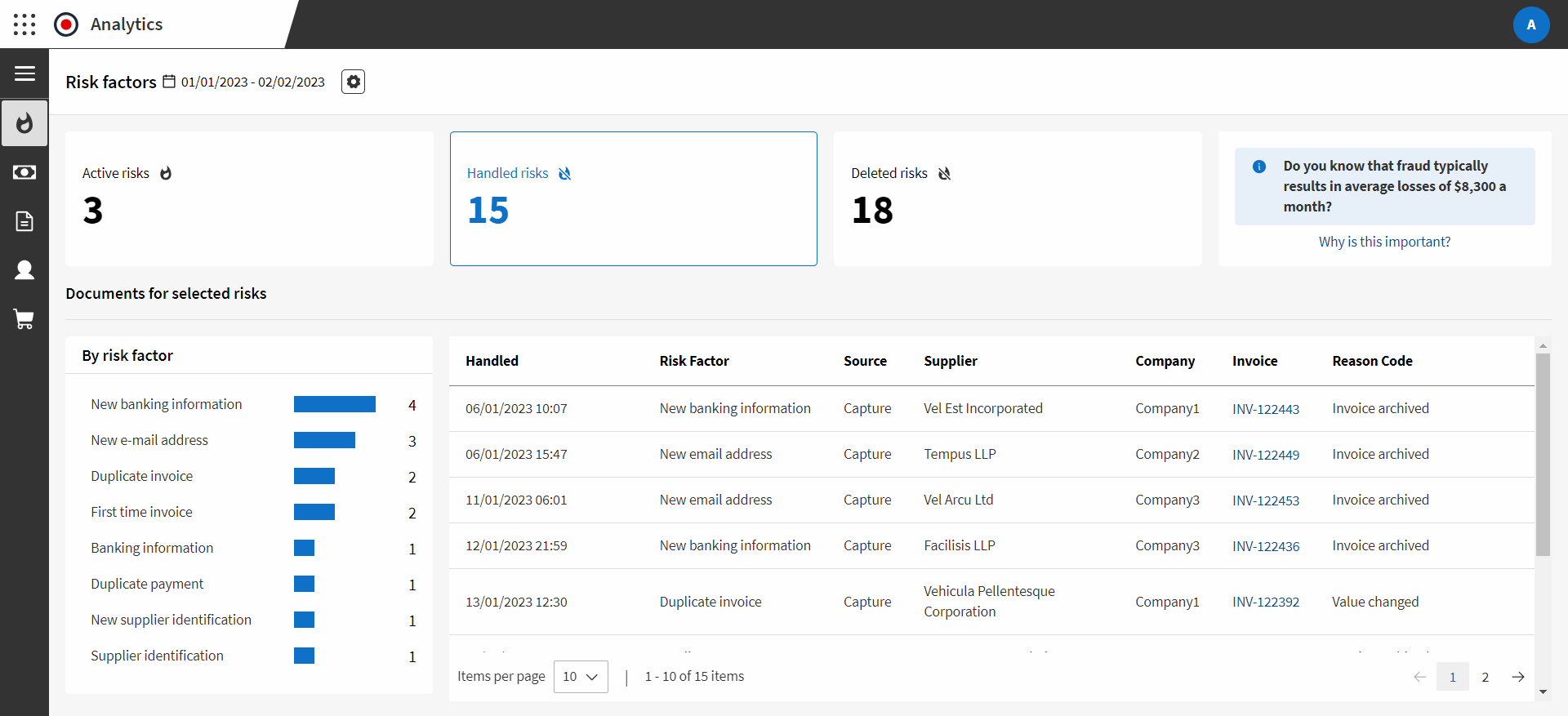
For organizations evaluating vendor fraud detection software or AI in accounts payable fraud detection, Medius provides proactive fraud prevention infrastructure rather than reactive correction tools.
Medius performs a twofold duplicate check, looking for duplicates currently in a workflow as well as archived invoices, across companies and stops them from being processed further if a duplicate is flagged. When vendor impersonation or fake vendors are suspected as supplier details or VAT registration don’t match master data on file, Medius flags the invoice and stops it in post control for the risk factor to be handled before it is paid; this also applies to mismatched invoice details that may have been changed prior to submission.
FAQ
Duplicate payments, vendor impersonation, invoice manipulation, phishing/BEC attacks, and employee collusion are the most common forms of accounts payable fraud.
Automation enforces structured approval workflows, monitors vendor changes, and uses AI to detect anomalies before payments are released.
Yes. AI models identify patterns and similarities that traditional matching rules often miss, reducing overpayment risk.


