Software Comparison
Medius vs. Quadient
How do they compare for AP automation?

How do they compare for AP automation?
Medius AP automation is ideal for organizations requiring deep ERP integration, AI-powered invoice processing, and scalable workflows. Quadient is better for teams seeking AP automation with faster, simpler implementation.
Medius
Best for complex AP workflows, deep ERP integrations, and scalable automation
Quadient
Best for simpler AP automation with faster implementation and lower upfront cost
Key difference
Medius is built to handle complexity and scale. Quadient is built for straightforward AP processes with less configuration overhead.
Medius is an AI-driven AP and spend management platform designed to automate invoice processing, payments, and supplier interactions across complex finance environments. Its AP automation capability is AI-driven and considered its strongest differentiator, handling both PO and non-PO invoices with touchless processing across complex, multi-entity environments.
Medius is typically used by mid-market and enterprise finance and procurement teams that need deep ERP integration, flexible approval workflows, and built-in payment execution in a unified platform.


Quadient is an AP automation platform focused on core invoice processing, approvals, and payment workflows. It is designed to be straightforward to implement and configure, making it a common choice for smaller teams or organizations with simpler AP requirements.
Quadient is typically selected by teams that prioritize faster time to value, predictable pricing, and standard workflows over deep customization or complex integration.
AP automation is the use of software and AI to capture, process, approve, and pay invoices automatically, reducing manual work, errors, and processing time.
Most AP platforms automate the basics like capture, code, approve, and pay. Medius goes further
by applying AI across the entire invoice lifecycle, not just at the point of capture.
What Medius does differently:
PO and non-PO invoices are processed automatically using AI, without manual data entry
Touchless processing handles matching, coding, and routing without human intervention
Exception handling is automated based on configurable rules, reducing manual follow-up
Payments are executed directly within the platform, not handed off to a separate system
Workflows scale across multiple entities and ERP environments without additional configuration
A dedicated customer success team supports ongoing optimization after implementation
Spend visibility and cash flow reporting are available in real time

For finance teams where invoice volume, processing cost per invoice, and days payable outstanding
are the metrics that matter, the depth of automation Medius provides is meaningfully different
from a platform built for simpler workflows.
| FEATURE | MEDIUS | QUADIENT |
|---|---|---|
| Primary strength |
Scalable AP automation and payments
|
Core AP automation
|
| Built for |
Mid-market to enterprise finance teams
|
Smaller teams or simpler workflows
|
| AP automation |
AI-driven, touchless, handles complexity
|
Supports core AP processes
|
| Invoice capture |
Advanced AI-driven capture and routing
|
OCR-based capture
|
| Payments |
Built-in, native execution
|
Supported, may require setup
|
| Workflow flexibility |
Highly configurable
|
More standardized
|
| ERP integration |
Deep, broad ERP coverage via Medius Connect
|
More limited, varies by system
|
| Multi-entity support |
Yes, built for complex organizations
|
Limited
|
| Post-implementation support |
Dedicated customer success team
|
Standard support
|
| Implementation |
More robust, tailored setup
|
Faster, simpler implementation
|
| Pricing model |
Higher investment, negotiable
|
Simpler monthly pricing, lower cost
|
| Typical customer |
Complex, multi-entity organizations
|
Smaller teams, simpler requirements
|
The key differences between Quadient and Medius for AP automation become clear in three areas:
Automation depth
Medius applies AI across the full invoice lifecycle, including exception handling, intelligent routing, and touchless processing for both PO and non-PO invoices. Quadient automates core processes but is built for more standardized workflows where exceptions are less frequent.
ERP integration breadth
Medius offers deep, proven integration across a wide range of ERP systems via Medius Connect, with an established track record across multiple platforms. This breadth of integration experience is often a decisive factor for organizations evaluating both platforms. Quadient's integration capabilities vary depending on the systems involved and may require additional configuration.
Post-implementation support
Medius provides a dedicated customer success team after go-live, focused on helping organizations optimize their automation over time. This ongoing support structure is a differentiator for teams that want more than a one-time implementation.
Medius is the stronger fit when:

Medius automates 99.5% of non-PO invoice routing and reduces PO invoice processing time to 1 day, demonstrating its impressive efficiency.

Quadient is the stronger fit when:
Medius and Quadient both automate AP, but they are designed for different levels of complexity. Medius is the stronger choice for organizations that need AI-driven automation, broad ERP integration, and ongoing support to optimize performance over time. Quadient is a solid choice for teams that need core AP functionality with simpler configuration and lower cost. The right platform depends on the complexity of your current workflows, your ERP environment, and the level of support you need after go-live.

Ardent Partners
2026 AP and Payments Market Leader and Elite Performer in AI innovation
The Hackett Group SolutionMap
2026 Value Leader
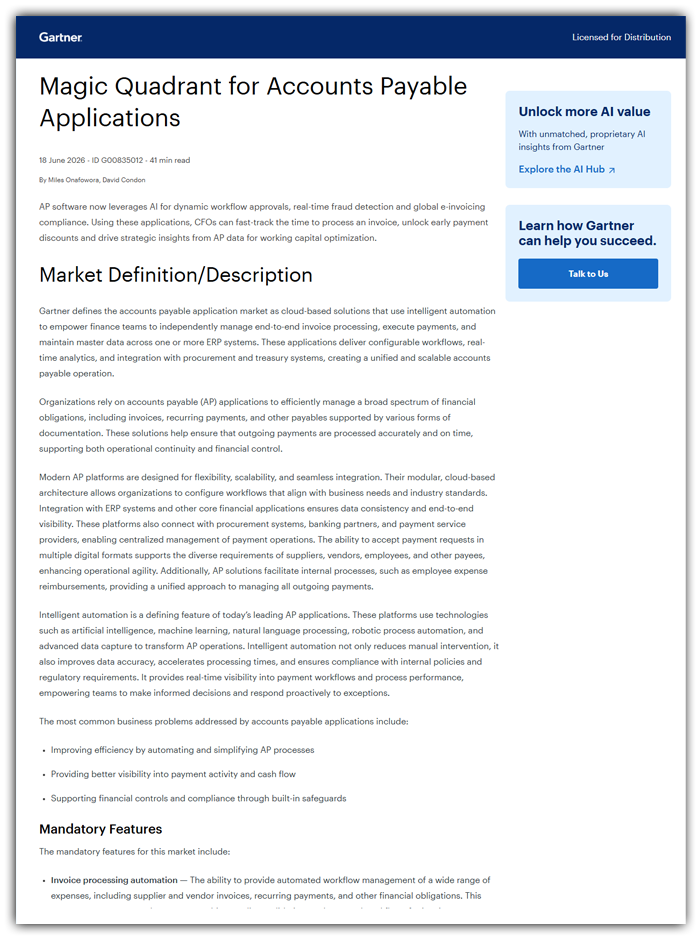
Gartner®
Medius has been
recognized by Gartner®
Medius is an AP automation platform designed for complex workflows, broad ERP integrations, and scalability across multiple entities. Quadient is a simpler AP solution focused on core invoice processing and approvals, typically chosen for faster implementation and lower cost.
Quadient handles core AP processes well. For organizations with complex workflows, including multiple entities, non-standard approval routing, or high exception volumes, Medius offers more flexibility and automation depth.
Medius offers deeper and more broadly proven ERP integration capabilities via Medius Connect, with established experience across a wide range of ERP systems. Quadient's integration capabilities vary depending on the systems involved and may require additional configuration.
Generally yes. Quadient typically offers simpler monthly pricing with a lower upfront cost. Medius pricing may require a higher investment and a more structured contract, though pricing is negotiable. Organizations that choose Medius generally do so because the automation depth, ERP integration breadth, and post-implementation support justify the difference.
Medius provides a dedicated customer success team after go-live to help organizations optimize their automation over time. This ongoing support structure is a differentiator for teams that want continued assistance beyond initial implementation.
Medius is generally the better fit for growing organizations because it scales with increasing workflow complexity, additional entities, and new ERP environments. Quadient is better suited for teams with stable, well-defined AP requirements.
For organizations that have outgrown Quadient due to increased invoice volume, added complexity, or new ERP integration requirements, Medius is a natural next step. Quadient remains a strong option for teams whose requirements stay simple and stable.
See how it works.
Get the latest research and insights in accounts payable.
What makes Medius different?


