The Medius Source-to-Pay Agentic Roadmap
Why the agents you can actually deploy in finance are credible only because of the foundation underneath them.
By Graeme Chard, SVP Product Marketing at Medius
Pick a random Monday in any AP team's inbox. There are supplier emails asking when their invoice will get paid. There are mismatched POs where the receipt has not posted yet, but the invoice has arrived. There are coding questions that need a person who knows the chart of accounts. There are contract terms an approver wants to verify. There are statements from suppliers that don't match. There are anomaly flags from overnight. Somewhere in the pile, there is an actual fraud attempt or a duplicate payment.
And that scene plays out beyond AP. Procurement teams have a parallel queue: supplier onboarding requests, contract intake, category management decisions. Expense and payments teams have another. The detail differs but the pattern is the same. Most of that work does not need a human to start, a lot of it does not need a human to finish, and almost all of it has been waiting for the kind of AI that can act on finance data, not just talk about it.
That AI is here, and most of the conversation about it is misleading. Vendors are announcing agents in 2026 the way they announced cloud in 2010, with a rush of marketing claims that obscure which capabilities are actually deployed, in which environments, with which accuracy and against which audit trail.
The pattern that holds up is a maturity curve. Extract, then Assist, then Act, then Orchestrate. Each stage is a precondition for the next, and each one is harder to skip than the marketing suggests.
Four stages, mapped to what is actually shipping
The four stages describe what AI does in finance, not how mature the technology behind it is. Extract is the deterministic work of reading an invoice or a contract or a supplier form. Assist is providing reasoning support to a human who is making a decision. Act is taking autonomous action within bounded scope and defined guardrails. Orchestrate is coordinating multiple agents and policies across a platform.
Most software vendors collapse these into a single agent claim. The honest version describes what is live, what is in development, and what is on the roadmap, then ties each capability to the right stage of the curve.
The agent maturity curve
Each stage solved at scale before the next one starts. Live, in development, on the roadmap.

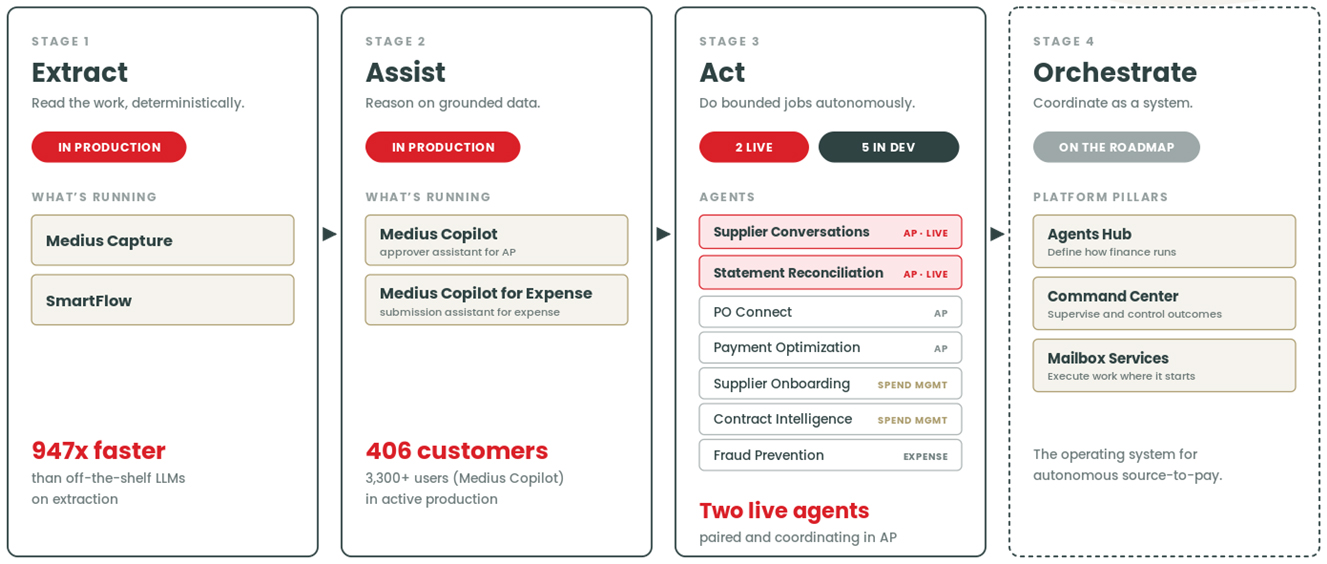
Lifestyle tags: AP • Spend Management (upstream) • Expense (downstream).
Status reflects production deployment as of 2026. Roadmap items are not dated externally.
Figure 1. The agent maturity curve. Each stage solved at scale before the next one starts.
What follows is the version for Medius. Each stage has been solved at scale before the next one starts.
Stage 1: Extract (in production)
Extract is the foundation. The first article in this series introduced the term Grounded AI: an AI system anchored by proprietary, human-validated data and specialized models, with the goal of deterministic accuracy in finance. The headlines bear repeating here.
Medius Capture runs at 96.3% touchless processing for top-performer customers on PO invoices. SmartFlow auto-fills coding, tax, and approver values at 95%+ precision after learning from just two invoices from a new supplier. The pipeline runs roughly 1000x faster and 25x more cost-effectively than off-the-shelf large language models for the same extraction work, because extraction is a deterministic problem and deterministic problems get solved better and cheaper by purpose-built models.

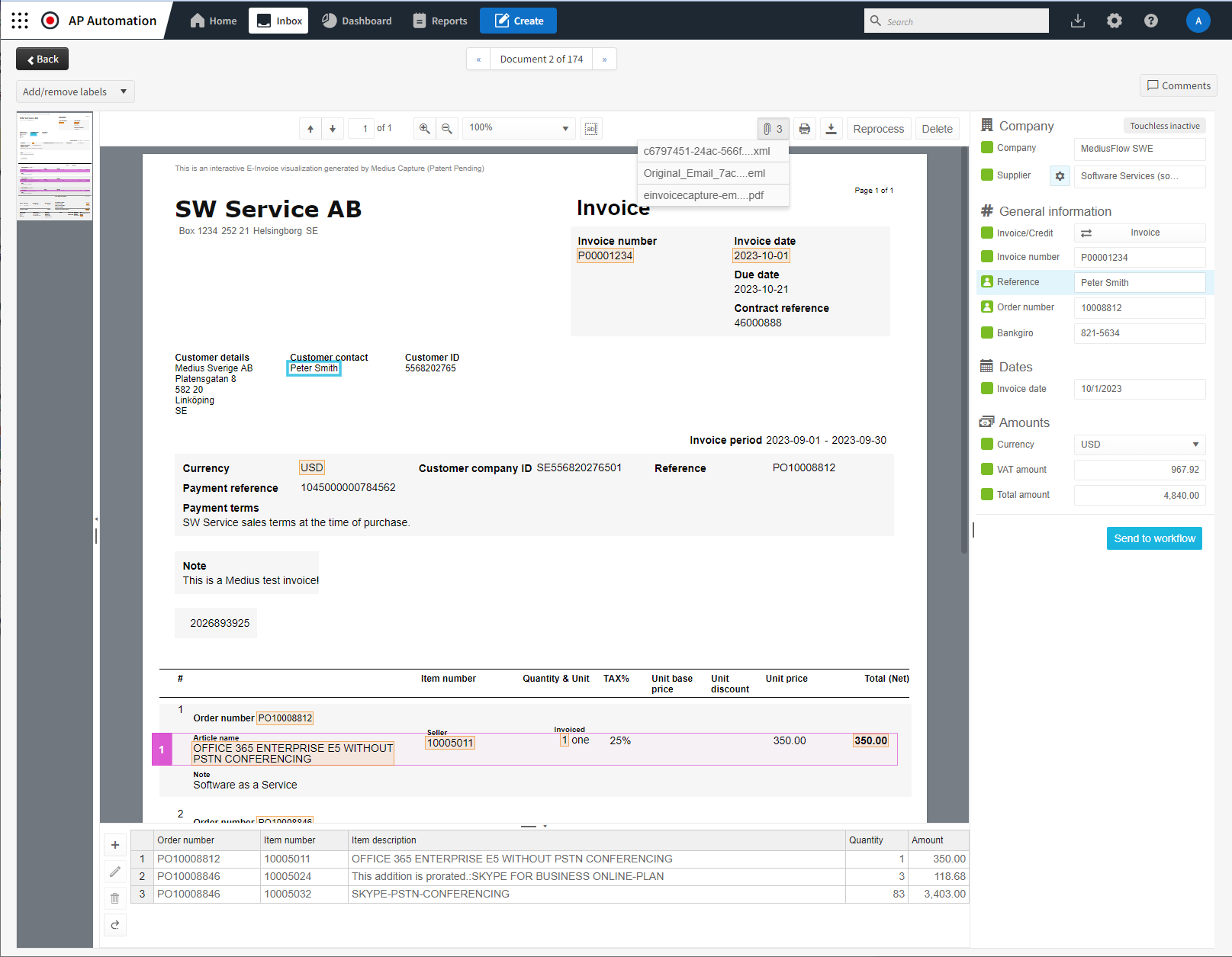


The point of recapping is not the numbers. It is that everything in stages 2, 3, and 4 acts on data this stage produced. An agent that takes action on incorrect extraction takes the wrong action. Extract is the precondition everything else inherits.
Stage 2: Assist (in production)
Once the data is grounded, you can put an LLM on top of it to help humans make decisions. That is the assistant pattern, and it is the gating step between extraction and autonomy.
Medius Copilot is in production at more than 400 customers with 3,300+ users. It surfaces relevant invoice history, flags anomalies, summarizes context, and answers free-text questions from approvers. Medius Copilot for Expense extends the same pattern into expense management. The LLM does the language. The grounding is what makes its answers correct.

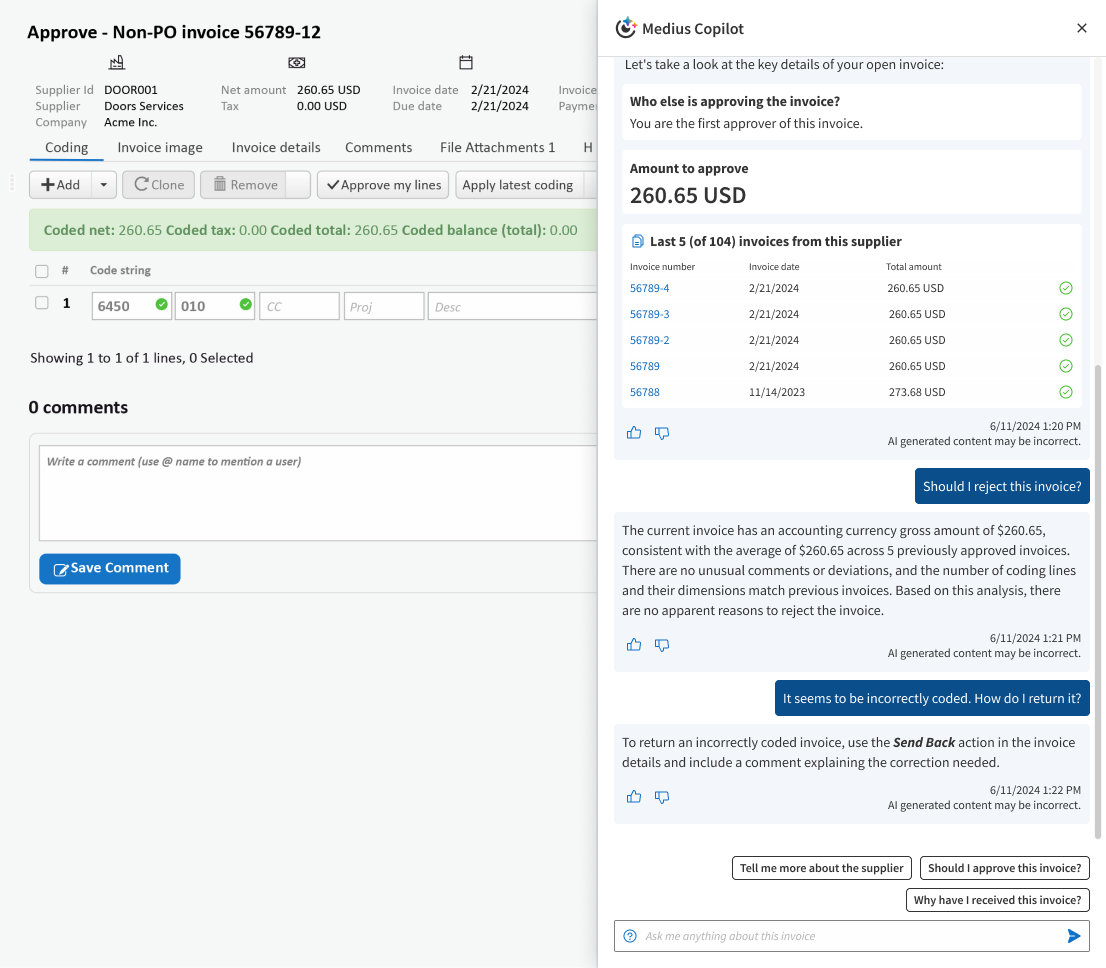

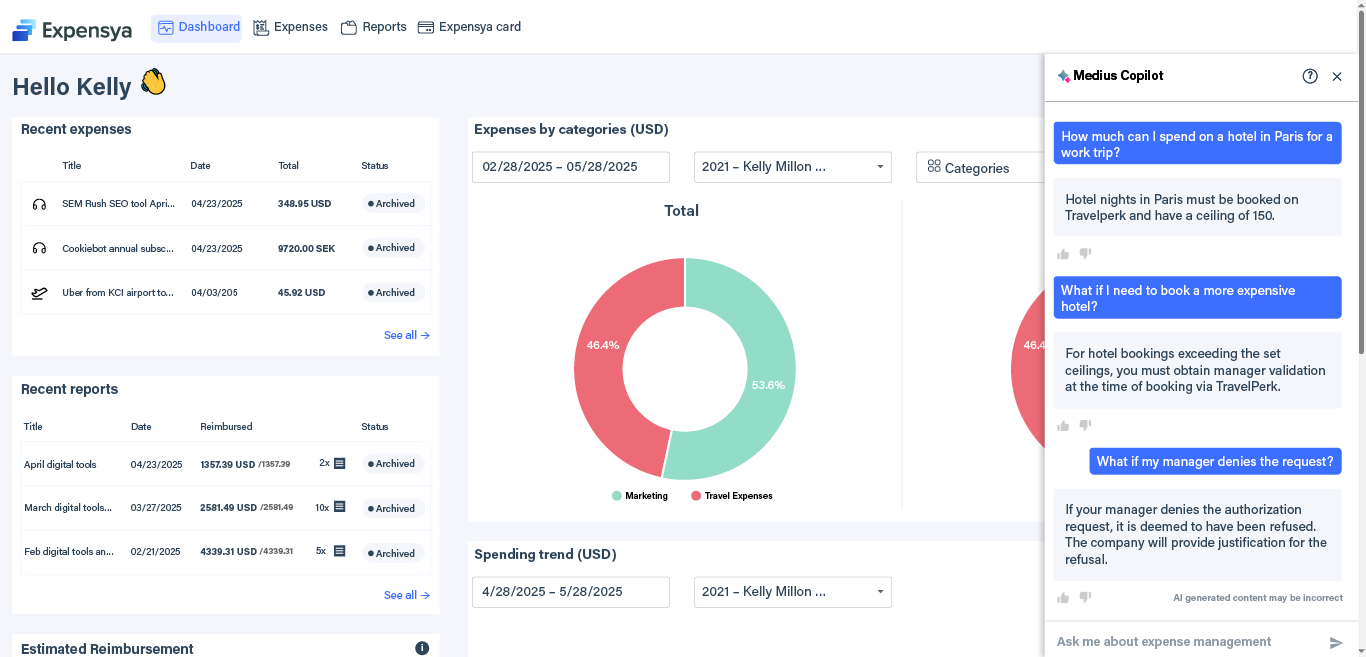
Why this matters for the curve: assistants build the trust that organizations need before they grant autonomy. A finance leader who has watched their team use an assistant for six months has a much better sense of where the AI is reliable, where it is not, and what guardrails they want when they move toward action. Skipping Assist means asking organizations to grant autonomy on day one. Few will, and fewer should.
Stage 3: Act (in production and in development)
Act is where agents take real action on real work, within bounded scope. Medius has two agents live in production today, paired and working together in AP, and five more in development, each tied to a specific category of work that an AP or procurement team currently does manually.
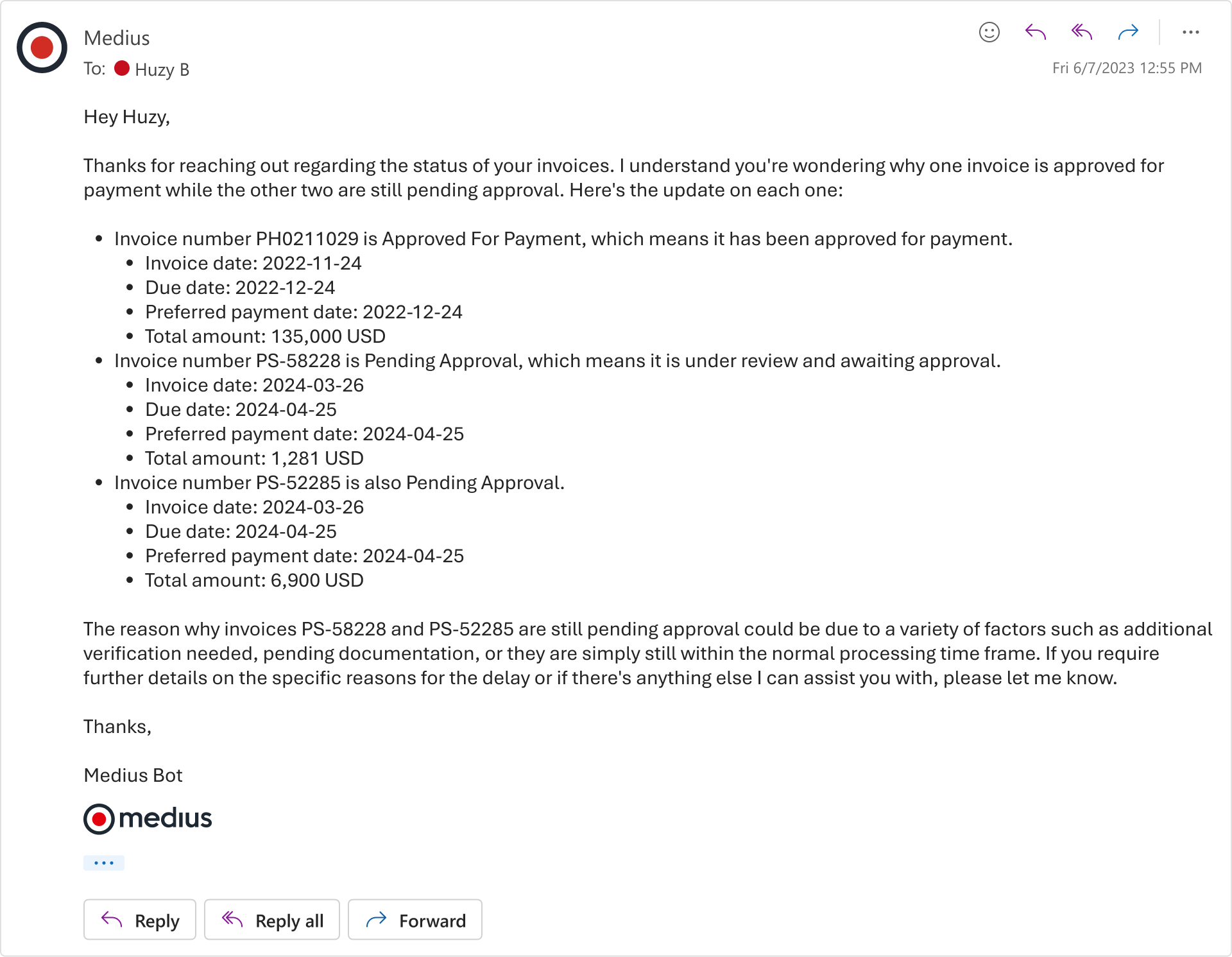
Supplier Conversations is one of the live agents. It classifies the intent of vendor emails, pulls the relevant context from the platform, and responds within defined guardrails. It currently handles around 13,000 supplier emails a month across 160 customers. AP teams using it report dropping from roughly 8 hours a week spent on managing supplier emails to 30 minutes, a 94% reduction in inbox time. The 30 minutes left over is the small subset of supplier interactions that genuinely need a human, with the routine work cleared out of the way.


“I thought the biggest benefit would be time savings, but really, it was the team engagement. They were excited, energized, and curious in a way we don’t always see in AP.”
Dana Frape
Manager of Financial Shared Services, on her AP team using Supplier Conversations

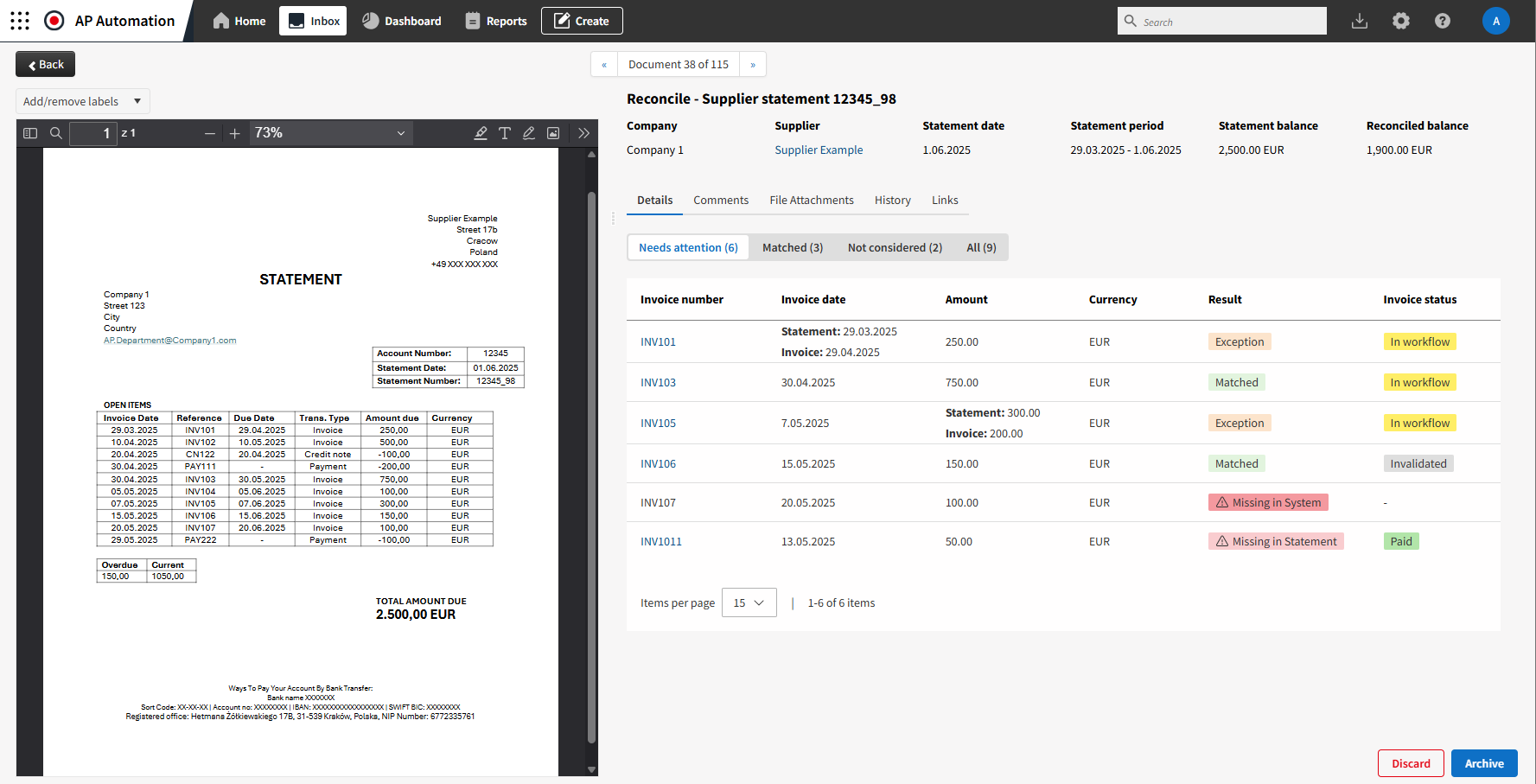
Statement Reconciliation is the second live agent, paired with Supplier Conversations. When a supplier emails a statement, Supplier Conversations captures it. Statement Reconciliation extracts the data, matches each line against AP records, and categorizes the result: matched, exception, missing in statement, missing in system. Discrepancies route to a human in the workflow with full audit trail. Two agents, one piece of supplier traffic, handled end to end before anyone touches it. This coupling is the start of what we will see in stage 4, orchestration between agents.

Five new agents are in development. The set extends the live foundation across the source-to-pay lifecycle.
Two run inside AP itself. PO Connect resolves invoice-to-PO mismatches by matching line items against descriptions, context, and historical patterns, removing the messy middle from AP. Payment Optimization tunes payment timing to capture discounts and balance supplier risk, turning when-to-pay from a process step into a working-capital lever.
Two sit upstream of AP, in spend management. Supplier Onboarding captures, validates, and completes supplier data through email, meeting suppliers where they are rather than forcing portal adoption. Contract Intelligence automates contract intake, extracts terms, dates, and obligations into structured data, and surfaces risks across the spend lifecycle.
One runs downstream, in expense management. Fraud Prevention stops fraudulent transactions on expense cards before loss occurs, moving from detection-after-the-fact to prevention-before-loss.
The principle binding them is the same: autonomy is granted by scope and governed by guardrails. Each agent has a bounded job and a defined outcome. None is general AP automation. All are specific. Together they trace the full source-to-pay arc.
The compounding effect of those agents shows up in cycle time. Industry average is 9.2 days to process an invoice. Industry best-in-class is 3.1 days. Medius customers average 5.1 days on PO invoices. Medius top performers run at 1.4 days, 6.5x faster than industry average. Each layer of the curve contributes a different compression: faster extraction, faster assisted approval, faster autonomous handling of the supplier traffic that used to clog the queue. Stage 4 is what compounds them further.
Medius in Ardent Partners' 2026 AP Automation & Payments Technology Advisor
Independent analyst evaluation by Andrew Bartolini, January 2026.

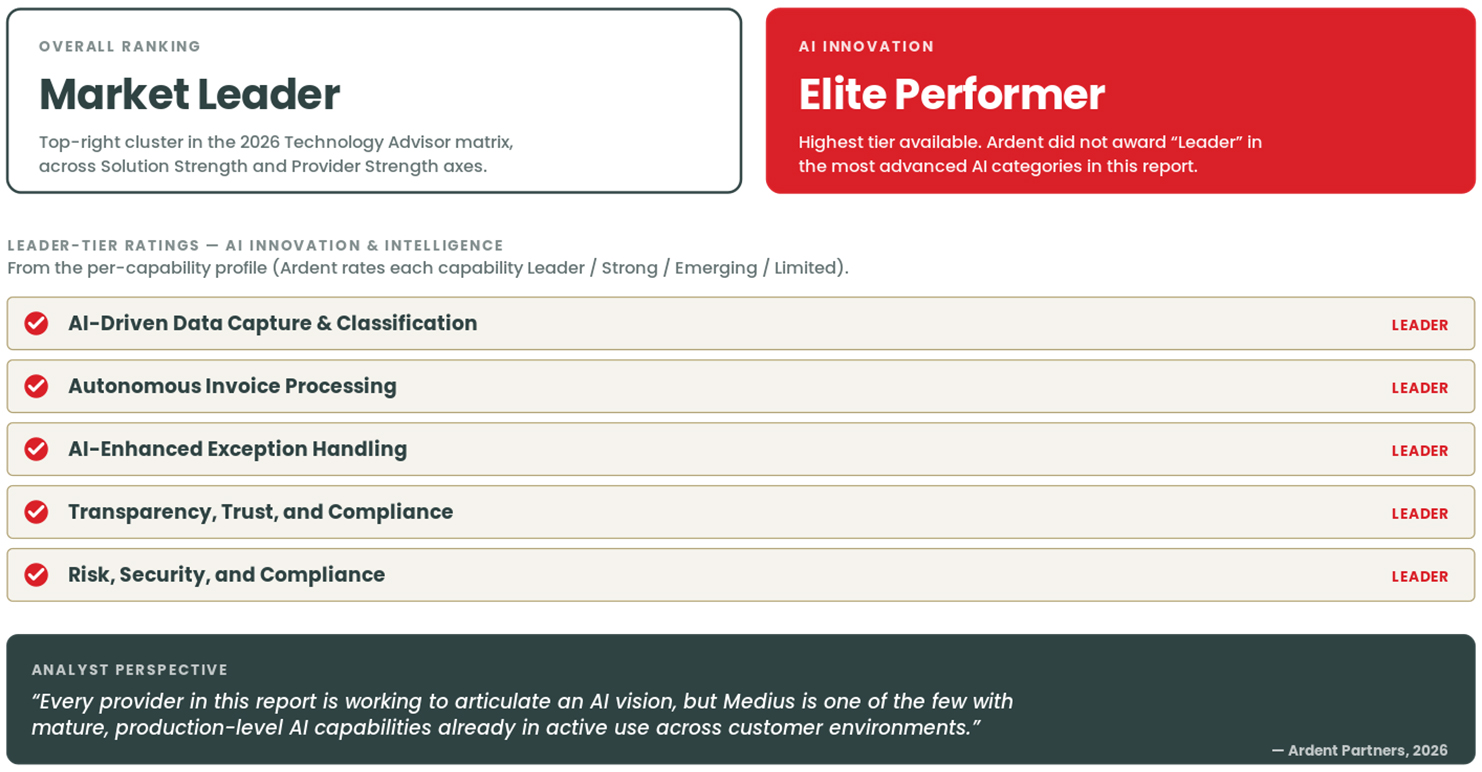
Source: Ardent Partners' 2026 AP Automation & Payments Technology Advisor (Andrew Bartolini, January 2026). Capability ratings from Medius's Capability Profile.
Figure 2. Medius rankings in Ardent Partners' 2026 AP Automation & Payments Technology Advisor.
Stage 4: Orchestrate (on the roadmap)
Stage 4 is where individual agents become a coordinated system across the source-to-pay lifecycle. The Medius Agent Platform is on the roadmap, with three pillars that together describe how autonomous finance actually runs.
The Medius Agent Platform
Three platform pillars, grounded agents, one data foundation, end-to-end governance.

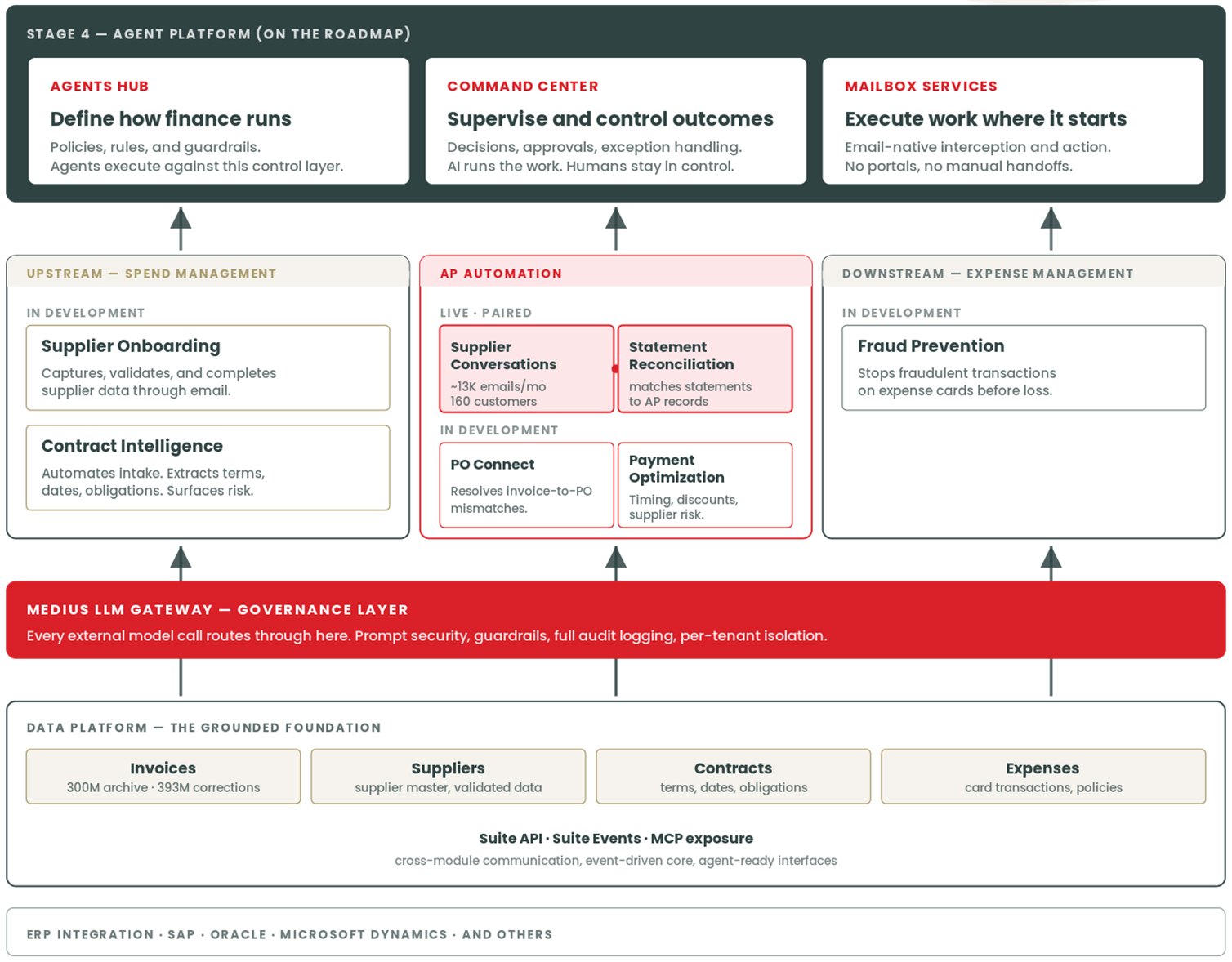
Figure 3. The Medius Agent Platform. Three pillars on a shared data foundation, governed end-to-end.
Agents Hub is where finance defines how the work gets done. Policies, rules, and governance live here. When a controller updates an approval policy, the change propagates to every agent that needs to know.
Command Center is where finance supervises and controls outcomes. Decisions, approvals, and exception handling happen in one place. AI runs the work. Humans stay in control.
Mailbox Services is where agents intercept and act on requests directly from email. The work gets done where it starts, without portals or manual handoffs.
Each pillar runs on the same data foundation, the same governance layer (the Medius LLM Gateway, which logs every external model call and enforces guardrails), and the same architectural pattern: task agents on top of a shared Data Platform with named ERP MCP integration points. Stage 4 is what binds them. The individual agents do the work. The platform defines how, supervises the doing, and lets the work happen where it starts.
The wider lens: Spend Autopilot
The maturity curve describes the agents. The wider question is what they enable for the finance function.
Most AI-in-finance discussion fixates on AP clerk replacement. That is the narrowest possible read. Once the maturity curve is in place across the lifecycle, three outcomes become available to the finance function.
Touchless processing means most invoices, supplier interactions, and expense submissions clear without manual effort. The friction lives in the exceptions, and the platform routes those to a human only when risk, ambiguity, or exposure exceeds the policy threshold the controller defined.
Autonomous governance means policies enforce themselves. An unauthorized supplier bank-detail change is not an operational issue, it is a balance-sheet risk. The platform monitors changes continuously, applies the policy before execution, and pulls in a human only where verification is required.
Proactive optimization means the system models cash position, discount yield, and supplier risk and acts within defined guardrails. Treasury reviews shift from manual reconciliation to exception management. Finance moves from operating the process to setting the policy that runs it.
This is what Spend Autopilot means. Not replacing the finance team, but progressively embedding agent-driven capacity across the entire source-to-pay function. The named agents above sit at the foundation of it. Stage 4 is what extends their reach across the lifecycle.
Why the curve cannot be skipped
The reason most agent announcements in finance software in 2026 will not survive contact with production is not the model layer. It is the absence of the layers underneath.
An agent that takes action on extraction it cannot trust takes the wrong action. An agent that calls an LLM without a governance layer cannot pass an audit. An agent without an event-driven platform to act on can read state but cannot do work. Stages 1 and 2 are the preconditions for Stage 3. Stage 3 is the precondition for Stage 4.
Medius has solved each in sequence, and across the source-to-pay lifecycle. Extraction has been in production for over a decade. Assistants have been in production for years. Two autonomous agents are live in AP today, with Supplier Conversations in market since 2024. Five more span AP, spend management, and expenses, each tied to a specific category of work. The platform that orchestrates them is on the roadmap.
That is what makes the agent roadmap a credible extension of the work, not a leap into something new. The next piece in this series turns to what happens when vendors do try to skip ahead, and why most of those agents will fail an audit.


