What can Medius do that an ERPs native AP module cannot?
- Introduction
- Short answer
- ERP systems vs AP automation platforms
- Why enterprise AP workflows extend beyond basic transaction processing
- Where ERP-native AP modules typically fall short
- Advanced workflow orchestration
- AI-driven invoice processing and exception handling
- Supplier management and visibility
- Governance, analytics, and enterprise controls
- When organizations outgrow ERP-native AP functionality
- Why enterprises layer AP automation platforms on top of ERP systems
- FAQs
Medius manages how accounts payable work is executed. ERP systems manage how transactions are recorded. Those are different functions, and enterprise AP operations need both.
ERP-native AP modules handle structured transaction processing well, like clean invoices matched to purchase orders, standard approval paths, and consistent data formats. For simple, low-volume environments, that is sufficient.
Medius extends beyond that baseline by adding the workflow orchestration, AI-driven invoice processing, exception handling, supplier visibility, governance controls, and operational analytics that enterprise AP environments require as complexity and volume increase.
Short answer
ERP systems manage financial data. Medius optimizes how AP work actually gets done. While ERP-native AP modules support simple structured transaction processing, Medius adds the workflow, intelligence, and operational control needed to handle complex, high-volume AP environments.
ERP systems vs AP automation platforms
ERP systems are built to manage financial data consistently across the organization. They ensure that transactions are recorded correctly, reports are accurate, and financial controls are enforced at the data level.
AP automation platforms focus on execution. They sit on top of the ERP and manage how invoices move through the business, from capture and validation to approval, exception handling, and payment readiness.
In simple terms:
- ERP systems act as the system of record
- AP automation platforms act as the system of workflow and optimization
Both are essential, but they solve different problems. ERP systems ensure financial accuracy and consistency, while AP automation platforms improve the efficiency and reliability with which work gets done across increasingly complex AP environments.
Why enterprise AP workflows extend beyond basic transaction processing
Accounts payable is not just a data entry process. It is an operational workflow that requires coordination across teams, systems, and suppliers.
In real-world environments, AP teams deal with incomplete or inconsistent invoice data, multi-step approval processes, supplier inquiries, disputes, and exceptions that require investigation. These are not edge cases. They are part of daily operations.
As organizations scale, this complexity increases. More suppliers, more entities, and more non-PO invoices introduce variability that structured systems alone cannot efficiently manage.
Managing that complexity requires more than transaction processing. It requires systems designed to orchestrate workflows, reduce manual effort, and maintain control across all scenarios.
Where ERP-native AP modules typically fall short
ERP AP modules are designed for structured, predictable processes. They perform well when invoices are clean, approvals are straightforward, and workflows follow a consistent path.
But most AP environments do not stay that simple. As volume and complexity increase, teams often encounter:
Manual invoice capture and exception handling
Rule-based workflows that break with real-world complexity
Limited visibility into non-PO and line-level invoice data
Minimal risk detection beyond basic duplicate or rule checks
Reporting that shows what happened, not what needs attention
These challenges do not reflect weaknesses in ERP systems. They reflect the reality that ERP platforms are built to record transactions, not to manage dynamic, high-volume workflows.
Advanced workflow orchestration
Medius introduces a layer of workflow orchestration that actively manages how invoices move through the organization.
Instead of relying on static approval paths, workflows can adapt based on:
Business rules
Invoice attributes
Supplier behavior
Exception conditions
This allows organizations to standardize processes while still handling real-world variability.
Workflows are not just routed. They are continuously monitored, measured, and refined. As complexity grows, this becomes critical to maintaining efficiency and consistency across large volumes of invoices.
AI-driven invoice processing and exception handling
ERP systems typically depend on structured data inputs, which limits their ability to handle variability in invoice formats and content.
Medius extends this by applying AI to:
- Interpret invoices across formats
- Validate data against ERP records
- Identify discrepancies early
- Prioritize exceptions based on impact
This reduces the need for manual data entry and improves accuracy at scale. Unlike ERP-native approaches that rely primarily on static rules and manual exception handling, Medius uses AI to understand invoice data more deeply, prioritize what needs attention, and improve touchless processing over time.
Exception handling is a critical part of AP operations. As invoice complexity increases, so does the volume of exceptions. Medius is designed to manage these scenarios as part of the workflow, helping teams resolve issues faster while continuously improving performance.
Supplier management and visibility
Supplier interactions are a significant part of AP operations, yet they are often fragmented across email, portals, and internal systems.
ERP systems store supplier data, but they typically provide limited visibility into ongoing communication or invoice status. This can lead to delays, repeated inquiries, and increased workload for AP teams.
Medius centralizes supplier visibility and communication, allowing teams to:
Track invoice status in real time
Manage disputes more efficiently
Reduce manual follow-ups
As supplier networks grow, this visibility becomes essential for maintaining efficiency and improving supplier relationships.

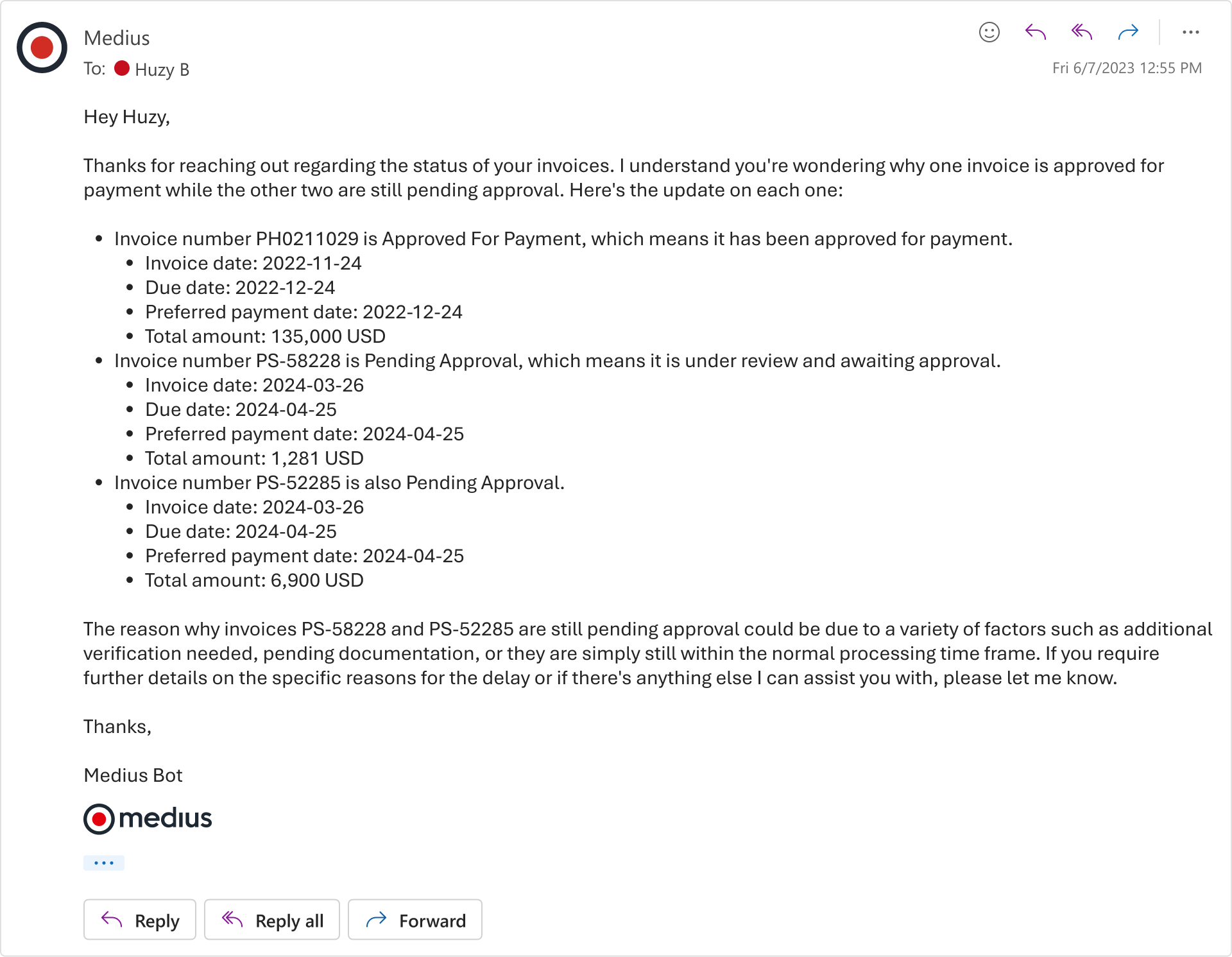
Governance, analytics, and enterprise controls
ERP systems enforce financial controls at the data level, ensuring transactions are recorded correctly and consistently.
Medius extends those controls into workflow execution. It ensures that approvals follow policy, decisions are traceable, and actions are captured in audit-ready records. AI operates within these controls, supporting automation without introducing risk.
Medius also provides operational analytics that go beyond financial reporting. Finance teams can see how processes are performing in real time, identify bottlenecks, and improve efficiency across the AP function.
When organizations outgrow ERP-native AP functionality
Many finance teams begin with ERP-native AP because it is built into their existing system. For simpler environments, this can be enough.
As complexity increases, common signals start to appear:
- Manual work increases despite automation
- Approval cycles slow down or become inconsistent
- Visibility into invoice status declines
- Exception handling becomes a large portion of workload
- Scaling requires adding headcount rather than improving efficiency

When organizations begin experiencing similar struggles, its time for them to move from basic ERP functionality to a dedicated AP automation platform.
Why enterprises layer AP automation platforms on top of ERP systems
Enterprise organizations do not replace their ERP systems. They extend them.
As AP operations grow in scale and complexity, the gap between recording transactions and managing workflows becomes more pronounced. ERP systems provide the foundation, but additional layers are needed to optimize execution.
Organizations layer AP automation platforms on top of ERP systems to:
Increase automation beyond basic rules
Handle complex and non-PO invoices
Improve visibility into workflows and bottlenecks
Strengthen control and compliance
Scale operations without adding headcount
The ERP remains the system of record. Medius becomes the system that enables AP teams to operate efficiently in real-world conditions.
To see how Medius extends ERP systems with workflow orchestration, AI-driven invoice processing, and enterprise AP optimization, book a demo to explore how the platform operates in real finance environments.
FAQs
Medius extends ERP functionality by managing how AP work gets executed, not just how transactions get recorded. It adds workflow orchestration, AI-driven invoice processing, exception handling, supplier visibility, governance controls, and operational analytics on top of the ERP. ERP systems act as the system of record, while Medius acts as the system that optimizes how invoices move through real-world finance workflows.
ERP systems manage structured financial records and enforce consistency across transactions. Enterprise AP workflows involve variability, exceptions, supplier interactions, and multi-step approvals that require active workflow management. As complexity increases, organizations need systems that can orchestrate processes, handle exceptions at scale, and provide visibility into operations.
No. Medius sits on top of the ERP and manages workflow execution. The ERP remains the system of record for financial data. Medius handles the operational layer above it, including invoice processing, approval routing, exception management, supplier visibility, and analytics. Integration uses standard patterns that preserve the existing financial data infrastructure.
ERP AP modules focus on recording invoice data and supporting basic approval processes within a structured system. AP automation platforms focus on execution, managing how invoices get captured, validated, routed, and resolved across complex workflows. ERP systems ensure data accuracy, while AP automation platforms ensure operational efficiency and control.
ERP AP modules optimize for predictable processes with clean data and simple workflows. In enterprise environments, AP teams encounter variability, complex approvals, and frequent exceptions that require coordination and investigation. ERP systems can support these scenarios, but they cannot optimize them efficiently at scale.
Medius improves workflows by dynamically routing invoices, automating data capture, reducing manual effort in exception handling, and providing visibility into process performance. Workflows can adapt based on business rules and real-world conditions rather than relying on static paths. This allows finance teams to manage higher volumes with greater consistency and control.
Medius uses AI to interpret invoice data, identify discrepancies, and support decision-making within workflows. This allows it to handle variability in real-world invoice processing, including unstructured data and edge cases. ERP systems rely primarily on structured inputs, which limits their ability to adapt without additional automation layers.
Enterprises layer AP automation platforms on top of ERP systems to bridge the gap between recording transactions and managing workflows. As AP operations scale, the need for automation, visibility, and control increases. Platforms like Medius provide the tools needed to manage complexity without replacing core financial systems.


