Software Comparison
Medius vs. Basware
Which AP automation solution is best for you?

Which AP automation solution is best for you?
Medius and Basware are both enterprise AP automation solutions, but they take different approaches to automation, AI, and financial operations.
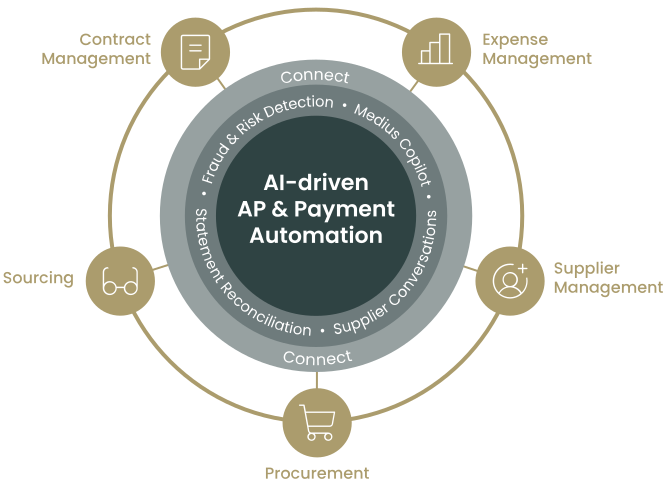
Medius is an AI-driven source-to-pay platform that combines AP automation, payments, procurement, supplier management, and fraud prevention in a single solution. Basware focuses on invoice lifecycle management, e-invoicing, and compliance-driven financial processes for global enterprises.
If you're evaluating Medius vs. Basware, the decision often comes down to the breadth of automation, AI capabilities, deployment speed, and how much of the source-to-pay process you want to manage on a single platform.
Medius is an AI-driven source-to-pay platform that combines AP automation, payments, procurement, supplier management, and fraud prevention. Basware focuses on invoice lifecycle management, e-invoicing, and compliance-driven financial operations for large global organizations.
Medius is an AI-native AP automation and spend management platform, purpose-built for end-to-end automation from invoice capture through payment. With 25+ years in AP automation, 10+ years of continuous AI development, and $400bn+ in annual spend managed across 3,000+ customers, Medius delivers measurable results at enterprise scale.
Key benefits with Medius:
Automate complex invoice through payment workflows, eliminating manual bottlenecks
Scale effortlessly across multiple ERPs, entities, and geographical regions with 100+ pre-built ERP connectors
Engage suppliers with AI-powered autonomous response tools that reduce supplier inbox management from ~8 hours/week to ~30 minutes (~94% reduction)
Protect your company’s cash with AI-driven fraud detection that reduces payment fraud and error rates by 90–95%
Deliver measurable cost savings: Medius customers reach best-in-class processing costs of ~$2.81 per invoice versus the $9.87 industry average (Ardent Partners 2025) — a difference that compounds to ~$967,000 annually at scale
Pricing is easy to navigate with two packaged plans:
AP essentials
A lower tier that covers the basics of automating invoice through payment.
AP 360
An inclusive package that includes top tier features and support plus a wider scope of AI-powered capabilities.
Basware supports complex invoice environments with strong compliance needs, often requiring more customization, cost, and time to deploy.
What to know about Basware:
At a glance
| CAPABILITY | MEDIUS | BASWARE |
|---|---|---|
| Accounts payable automation |
 Yes |
Yes |
| Payment automation |
Built-in payments platform |
 No native payment handling |
| Fraud & risk detection |
AI-based fraud scoring & 3-way match |
 Compliance-focused controls and risk management |
| Procure-to-pay (P2P) |
Unified procurement, AP & payments |
Full P2P with catalogs |
| Contract management |
Centralized storage & approvals |
Not offered |
| Sourcing |
Included in platform |
Not offered |
| Expense management |
Corporate card integration |
Not offered |
| ERP integrations |
100+ packaged integrations including Microsoft Dynamics, SAP S/4HANA, NetSuite, Oracle Fusion, JD Edwards, Infor and Yardi + REST APIs |
SAP-focused; middleware for others |
| AR automation |
Through partner |
AR portal only (not full automation) |
| Customer support |
Medius-led, hands-on, fast-response service |
Partner-led support model |
 Fully included
  Limited or partial functionality
  Not available
When evaluating AP automation vendors, there's more to consider than just flashy features. Without standardized, proven ERP integrations, you risk drawn-out implementations, costly custom work, and painful delays. The right vendor should connect to your ERP seamlessly, so your AP transformation starts delivering value from day one.

| FEATURE | MEDIUS | BASWARE |
|---|---|---|
| AI-powered AP automation |
Proprietary multi-stage AI pipeline (Siamese CNNs, LGBM ensembles, proprietary Markov models) — not rules-based OCR — trained on 2.4B+ invoice field data points |
AI-powered invoice processing and workflow automation |
| AI fraud detection |
Real-time scoring & alerts — 90–95% reduction in fraud and error rates |
Rules-based only |
| AI assistant (Copilot) |
Available now — 406 customers, 3,300 unique users (Feb 2026) |
Not available |
| Supplier conversations |
Autonomous AI agent handling ~13,000 supplier emails/month; reduces inbox management by ~94% |
Not available |
| Supplier onboarding |
Available in platform |
Not included |
| Procurement automation |
AI + catalog workflows |
Catalog manager included |
| Contract management |
Embedded in suite |
Not included |
| Analytics & reporting |
Self-service, exportable reports |
AI-powered analytics |
Medius and Basware both support enterprise AP automation, but they differ in how they deliver automation, scalability, and innovation.
Medius provides AI-driven invoice capture, automated coding, and intelligent routing, along with built-in payments and a unified procure-to-pay platform. It is designed for fast deployment and seamless integration across multiple ERPs and global entities.
Basware focuses on invoice lifecycle management, compliance, and global e-invoicing workflows designed for large enterprise environments. It is often implemented in large enterprises with established IT structures, where customization and control are prioritized over speed and flexibility.
Another key difference is innovation approach. Medius embeds AI across workflows, including fraud detection, supplier communication, and automation assistance, while Basware relies more on structured workflows and configuration-based processes.
Traditional AP automation relies on rigid workflows that can’t keep up with today’s invoice complexity. AI-powered AP automation learns, adapts, and proactively catches errors and fraud—freeing your team from repetitive, rules-based work. This Buyer’s comparison guide for AP automation helps you spot the differences that matter, so you don’t invest in yesterday’s technology.

Medius and Basware both serve enterprise-level invoice automation needs, but their strategies differ materially in AI depth, deployment speed, and total cost of ownership.
Choose Medius if you want:
Choose Basware if you need:
You may be ready for Medius if:
See Medius in action


"With Medius AP Automation we process 50% more invoices within the same time period compared to the previous solution. Since we have automated 3-way invoice matching in place, Medius AP Automation processes a large volume of invoices automatically, without anyone touching or seeing the invoices."
Boudewijn Rast
Group IT Manager
See how it works.
Download the latest AP insights and reports.
Talk to an expert to compare workflows side-by-side.
Medius and Basware are both enterprise AP automation solutions, but they differ in how they deliver automation and workflow management. Medius provides a cloud-based platform with AI-driven automation, while Basware focuses on structured invoice processing and compliance-oriented workflows.
Both Medius and Basware support enterprise AP automation, including invoice processing and approvals. Organizations evaluating the two are typically comparing a modern, AI-enabled platform with a solution designed around structured, compliance-driven processes.
Medius includes support for payments as part of its broader AP automation platform. Basware focuses primarily on invoice processing and automation, with payment capabilities handled separately depending on the solution setup.
Medius uses AI-driven automation to support invoice capture, coding, and workflow processes. Basware relies more on predefined rules and structured workflows, with a focus on control and compliance.
Medius is designed as a cloud-based solution with configurable workflows and pre-built integrations. Basware implementations may involve more configuration depending on the organization’s requirements and existing systems.
Both Medius and Basware support large, global organizations. Medius is designed to scale across multiple entities and systems within a unified platform, while Basware can support complex environments with structured workflows and configuration.